About Hippocampus kuda Bleeker, 1852
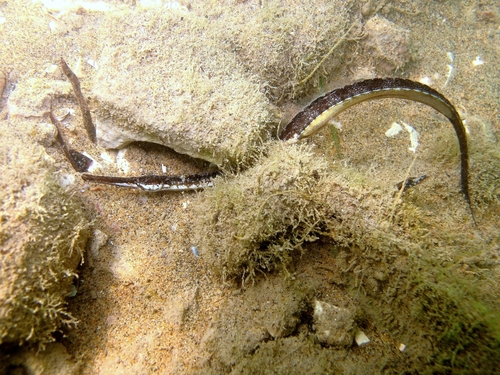
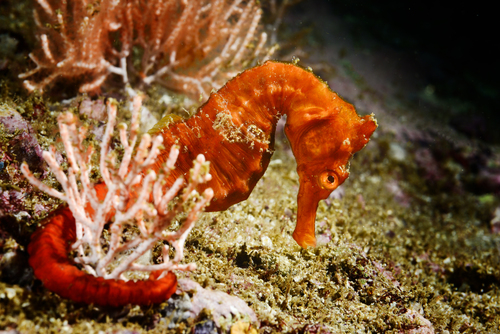
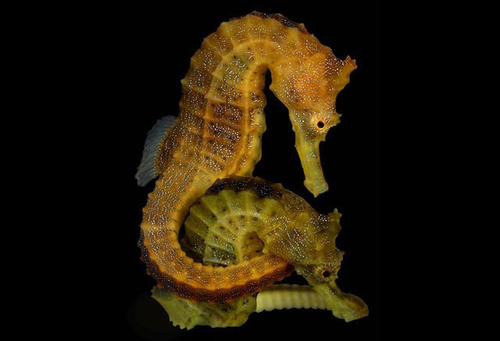
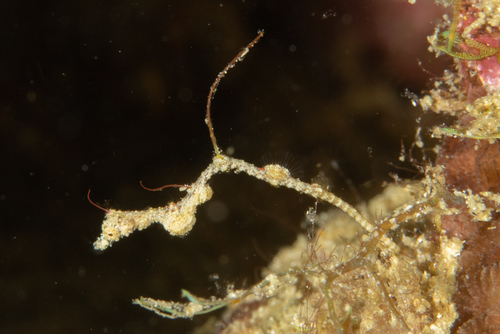
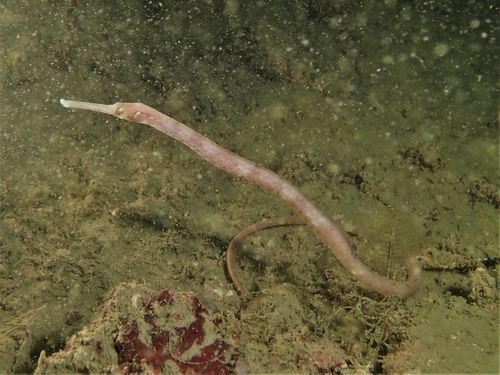
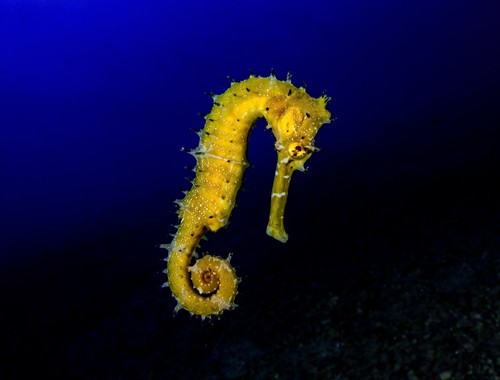
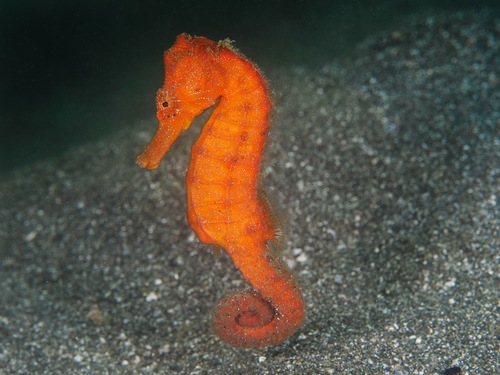
Physical description: The yellow seahorse, Hippocampus kuda, is a small fish that reaches a total length of 17–30 cm. Its body is quite large, elongated, and lacks spines, with all bumps being rounded. The head is relatively large compared to its body, and the snout is short and thick. The small coronet rises toward the rear, and may sometimes have more or less long filaments. Some adults have a black line running across the width of the dorsal fin. Body coloration is most often dark with a grainy texture, but can also be yellow, cream, or marked with reddish blotches and numerous small dark spots. This species has a tail that acts as a flexible, grasping appendage. It can bend its tail ventrally thanks to its body plates, which transfer force to the hypoxia muscle responsible for tail bending. Study of this musculoskeletal system allows for deeper understanding of seahorse anatomy. Distribution and habitat: Hippocampus kuda lives across the Indo-Pacific region, ranging from the northwest Indian Ocean to the central Pacific Ocean. Its range extends from the Persian Gulf to Southeast Asia, Australia, Japan, and several Pacific islands including Hawaii, and it is also found along the eastern coast of Africa from Tanzania to South Africa. The majority of the H. kuda population lives along the Chinese coast down to Australia. This species inhabits shallow waters up to 55 meters deep, found in estuaries, lagoons, harbors, littoral zones, and coastal seagrass beds. It occupies tropical, saltwater, and marine environments. Biological development and reproduction: Hippocampus kuda has a strictly monogamous mating system. Before mating, individuals perform a unique courtship ritual. Males change their color pattern, dance around females, and produce clicking sounds with their coronet. Eventually the male and female intertwine their tails, and the female deposits her eggs into the male's ventral brood pouch using an ovipositor. A single brood pouch can hold up to one thousand eggs, and development takes 20 to 28 days. The timing of birth depends heavily on monsoon patterns, lunar cycles, and water temperature; males typically go into labor during a full moon. Newborn baby seahorses have an average length of seven millimeters.