About Hippocampus ingens Girard, 1858
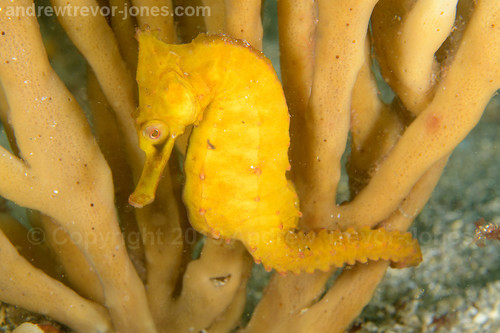
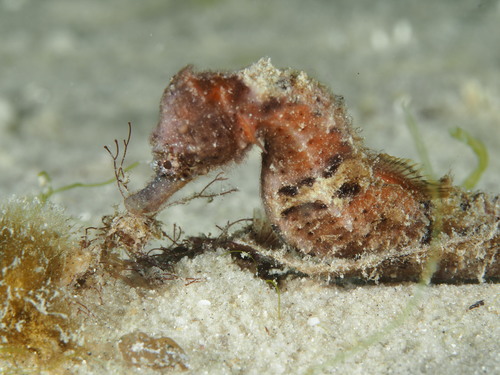
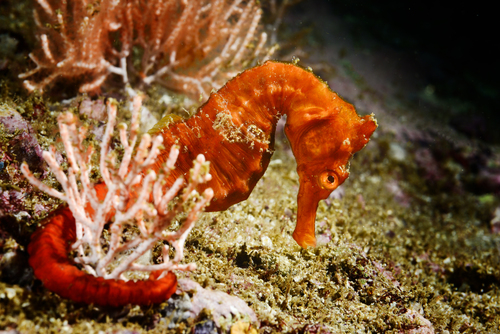
Hippocampus ingens, commonly called the Pacific seahorse, is one of the largest seahorse species. Adult Pacific seahorses measure 12 to 19 centimeters (4.7 to 7.5 inches) in height, with a maximum recorded height of 30 centimeters (12 inches). Newborn offspring are approximately 9 millimeters long at birth. While the species is larger than most other seahorses, this large size creates a challenge for its conservation. Common, widely favored conservation minimum size limits typically start at 10 centimeters, so accurate measurement of sexually mature Pacific seahorses is critical, as this measurement determines whether an individual will receive legal protection. Pacific seahorses can come in a range of colors, including green, brown, maroon, grey, and yellow. Males can be distinguished from females by their prominent keel. This species shares all common seahorse traits: a prehensile tail for anchoring, skin rather than scales, a digestive tract without a distinct stomach, no teeth, and the ability to move each eye independently. It is one of six species listed by the Convention on International Trade in Endangered Species of Wild Fauna (CITES) as being under the greatest threat from unsustainable harvest levels and international trade. The Pacific seahorse is distributed across the Pacific Ocean from Baja California to Chile, with an additional transient population off the coast of San Diego. The only known oceanic island population occurs around the Galapagos Islands, and additional populations are also located in northern Peru. Pacific seahorses are nocturnal, and inhabit a variety of subtidal habitats down to a maximum depth of 60 meters (200 feet). Their habitats include mangroves, seagrass meadows, rocky reefs, coral reefs, sponges, sea kelp, and eelgrass. They also camouflage themselves among the branches of gorgonians and black corals. South America hosts an abundance of aquatic ecosystems, making the region more vulnerable to environmental crime that harms species including the Pacific seahorse. Peru handles the largest volume of Pacific seahorse trade, and levels of environmental crime targeting this species are very high in the country. The first recorded observation of Hippocampus ingens at Guadalupe Island, a northern oceanic island off Mexico, occurred in November 2015. This location differs from the species' usual Eastern Pacific range. The species' presence at this new site may be linked to its vulnerable population status and long-distance dispersal, a behavior that other seahorse species have exhibited recently. CITES trade data for seahorses was not available until 2004, so before this date Latin American countries were not recognized as major participants in international seahorse trade. It is now known that countries including Peru and Mexico are among the largest contributors to this trade. Although the Pacific seahorse is native to the Eastern Pacific, its trade and exploitation extend far beyond this region. In captivity, female Pacific seahorses have been observed producing small broods when they are three months old. Sexually mature females often develop a dark patch below their anal fin. Males reach sexual maturity at approximately 5.4 centimeters (2.1 inches) in height. Unsuccessful reproductive activity in captivity has been recorded at around three months of age, while successful pregnancies can occur as early as six months of age. Like all seahorses, females deposit their eggs into the male's brood pouch. The male fertilizes the eggs inside the pouch and seals them into the structure. As embryos develop, the salinity of fluid inside the pouch changes to acclimate the developing embryos to the salinity of the surrounding seawater. Research indicates that male Pacific seahorses can brood up to 2000 eggs at once, and may brood multiple times over a single breeding season. After a 14-day gestation period, the male enters labor and expels the young from his pouch one at a time, a process that can sometimes take hours.