About Hippocampus histrix Kaup, 1856
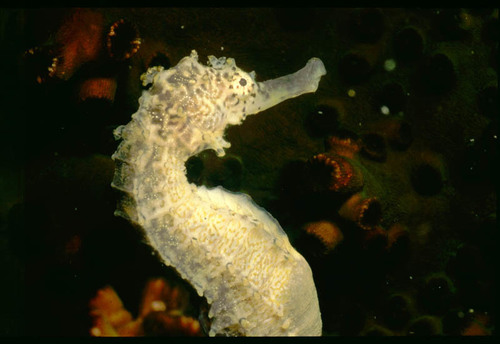
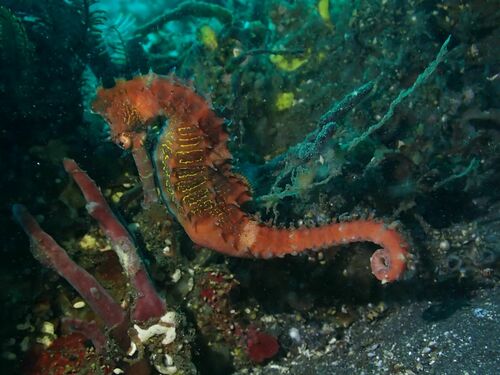
The spiny seahorse, scientifically named Hippocampus histrix Kaup, 1856, is a small fish that reaches a maximum length of 15–17 cm. It has a slender, elongated body completely covered in thorns. The thorns are sharp with dark tips, and are uniformly sized on its prehensile tail. Its trunk bears long thorns that extend up to the coronet, which holds 4–5 thorns. Its head also has numerous spines, especially on the forehead, cheek bases, nose, and above the eyes. The snout is very long and tapered. Body coloration is highly variable to match the seahorse’s surroundings, ranging from grey to cream, bright yellow, green, red, and even brownish. Coloring can be plain, or display different patterns on the sides and/or back. The snout is typically marked with one or more thin white stripes. This species is relatively rare, but widespread across the Indo-Pacific. In Australia, it has been recorded from south of Ashmore Reef in the Timor Sea, the Great Barrier Reef in Queensland, and Port Stephens in New South Wales. It is also found in Bali (Indonesia), Papua New Guinea, New Caledonia, and Japan. The spiny seahorse prefers relatively deep water between 10 and 95 m, and is most commonly found at depths below 15 m. It occurs across a range of substrates including sponges, weedy rocky reefs, and soft corals, but is found mainly on seagrass beds.