About Hippobroma longiflora (L.) G.Don
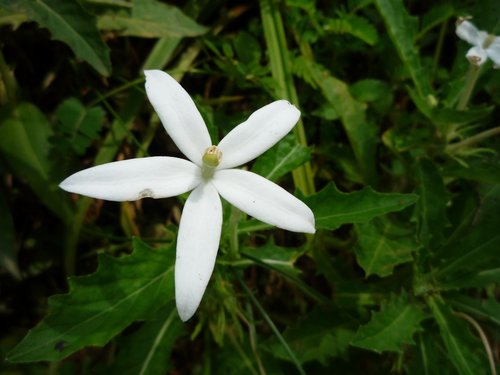
Hippobroma longiflora, commonly known as Star of Bethlehem or madamfate, is a flowering plant that belongs to the Campanulaceae family. It is the sole species in the monotypic genus Hippobroma. The species is endemic to Jamaica, which is located in the West Indies, but it has become naturalized throughout the American tropics, Madagascar, southern and southeastern Asia, and Oceania. It is a perennial herbaceous plant that reaches a maximum height of 35 centimeters. Its leaves measure 7 to 16 centimeters long and 1 to 3.7 centimeters wide, with coarsely toothed margins. The plant produces white five-petaled flowers with a slender floral tube; the tube is only 2 to 3 millimeters (0.1 inches) wide and 7 to 8 centimeters (2.8 to 3.1 inches) long. H. longiflora contains two pyridine alkaloids: lobeline and nicotine. The effects of nicotine and lobeline are very similar. Both produce psychoactive effects at small dosages, and cause unpleasant effects including vomiting, muscle paralysis, and trembling at higher dosages. Because of this, H. longiflora and its various synonyms are frequently noted for both its toxicity and its ethnobotanical uses.