About Hipparchia fagi Scopoli, 1763
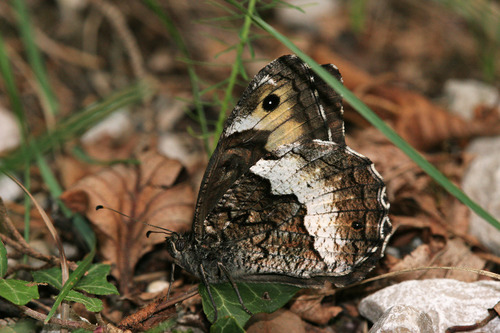
Hipparchia fagi Scopoli, 1763 is a species of butterfly with a wingspan ranging from 66–76 millimetres (2.6–3.0 inches). These are large butterflies, with dark brown uppersides on their wings and a fringed margin. A white submarginal band is present, and it is more distinct in females. Each forewing has one black eyelet at its apex. In males, the white band has a single very small eyelet on each hindwing, which sometimes has a white pupil. In females, the white band has one or two ocelli. The underside of the forewings is quite similar in appearance to the upperside. The hindwings are marbled brown and white with a broad white band. The white band along the internal edge of the underside of the hindwings is curved, while the white band on the underside of the forewings often does not have a significant indent. The colouration and pattern of these butterflies provide excellent camouflage on tree trunk bark, where the butterfly typically rests. When resting with closed wings, the eyespots are hidden. This species is similar to Hipparchia hermione, but it is larger than that species. It is also quite similar to Hipparchia syriaca and Hipparchia genava. The caterpillar of Hipparchia fagi has a pale brown head marked with four darker streaks. Its body is light brown, with a bifid posterior end, a dark brown dorsal band, and brownish lateral bands. Hipparchia fagi is a widespread endemic species of Europe, found across most of Europe, mainly south of the Alps. Confirmed recorded locations include Albania, Andorra, Austria, Bosnia and Herzegovina, Bulgaria, Croatia, Czech Republic, France, Germany, Greece, Hungary, Italy, Macedonia, Montenegro, Portugal, Romania, Russia, Serbia, Slovakia, Slovenia, Spain, Switzerland, and Ukraine. Its habitat includes broad-leaved deciduous forests, coniferous woodland, grassy vegetation, woodland glades, and woodland rides. It can be found from sea level up to 1,600 m elevation.