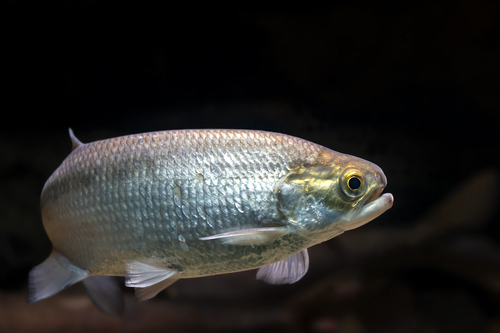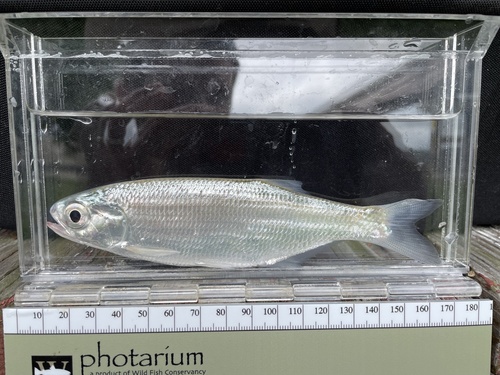
About Hiodon tergisus Lesueur, 1818
Hiodon tergisus, commonly called the mooneye, is a species of freshwater fish that is widespread and endemic to eastern North America. Its distribution ranges as far north as Hudson Bay and as far south as the Mississippi Delta, stretching west to central Alberta, Canada, and east to the western edge of North Carolina. Historically, mooneyes occurred in all the Great Lakes except Lake Superior. Their populations in Lake Michigan and Lake Erie have declined over time. Currently, the species is found mostly in larger rivers, while historically it also inhabited many smaller tributaries. The accuracy of the species’ historical distribution is uncertain, because H. tergisus has often been misidentified as other species such as gizzard shad and alewives. Changes between the species’ current and historical distribution are thought to result from dam construction that blocks fish migration between smaller and larger rivers; climate change and pollution may also impact its distribution. Mooneyes live in clear river and lake habitats, and are largely intolerant of turbid water. They are typically active during the day. As surface feeders, they primarily eat aquatic and terrestrial insects, but they also consume crustaceans, mollusks, and small fish. Young mooneyes usually feed in benthic areas, eating immature caddisflies, mayflies, midges, corixids, and plecopterans. No predators of adult mooneyes have been documented, but young mooneyes are often preyed on by larger piscivorous fish. Two trematode parasite species, Crepidostomum hiodontos and Paurorhynchus hiodontis, are specific to H. tergisus. Researchers think these parasites are acquired through the fish’s ingested food. To date, no research has investigated whether, or how, these parasites affect the population size or ecology of mooneyes. H. tergisus shows latitudinal variation in growth rates: northern populations mature faster than southern populations. This pattern may be caused by lower water turbidity at northern latitudes.