About Hinea brasiliana (Lamarck, 1822)
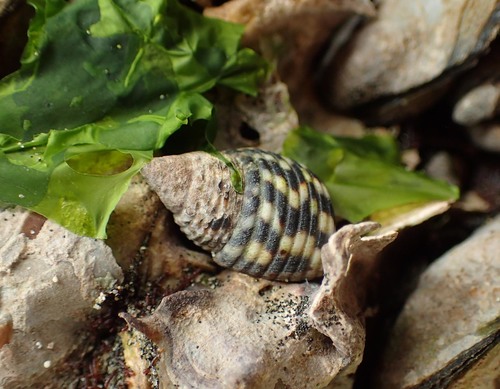
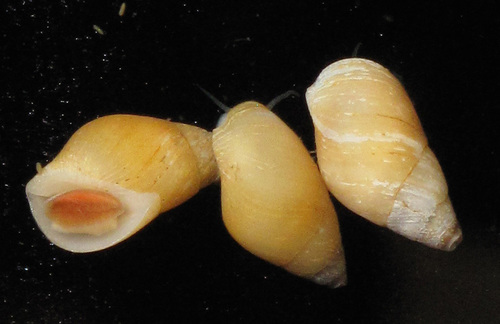
The shell of Hinea brasiliana is thick and heavy, reaching a length of about 21 mm (0.8 in). It has a narrowly conical shape, and can be either smooth or have shallow grooves between approximately six spiral whorls. The aperture is small and constricted by a callus, and the columella (the central structural axis of the shell) is thick. The shell is thin at the aperture's edge, but thickens rapidly moving away from the edge; this thickened section is marked with weak raised ridges called lirae. A horny operculum is present, which closes the shell when the soft body of the snail is retracted inside. The shell is white on both its inner and outer surfaces. When new, the outer surface is covered by a yellowish-brown periostracum, which eventually wears away. In Australia, Hinea brasiliana ranges from the Burnett River in Queensland south to Mount Gambier in South Australia. In New Zealand, it occurs on the North Island, and it is also present on Lord Howe Island, Norfolk Island, and the Kermadec Islands. This species lives in the mid-littoral zone of rocky shores, found among boulders and rubble. It prefers high-energy shores, but avoids the most exposed locations that experience heavy wave action. It is very common in Australia, so abundant that empty shells from dead individuals make up a large portion of the shell debris that washes up on beaches.