About Himatione sanguinea (J.F.Gmelin, 1788)
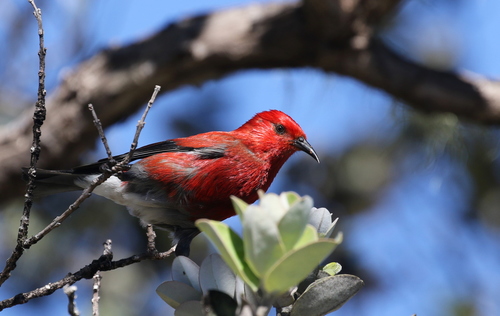
Full-grown ʻapapane (Himatione sanguinea) are small birds, measuring 13 cm (5.1 in) long. This species shows sexual dimorphism in body mass: males weigh 16 g (0.56 oz) on average, while females have an average mass of 14.4 g (0.51 oz). Adult ʻapapane are primarily bright crimson in color, with distinct white feathers on their undertail coverts and lower abdomen. Their flight feathers (primaries) and tail feathers (retricies) are black. Juvenile ʻapapane are yellow-brown and gray, but retain the same white plumage seen on adults. They molt into their characteristic crimson adult plumage over a period of two years. ʻApapane are often observed holding a tail-up posture that displays their white feathers. ʻApapane inhabit native mesic and wet forests that are dominated by ʻōhiʻa and koa trees. Their range is extensive, and their population densities shift as they make frequent temporal and seasonal migrations to find flowering ʻōhiʻa. While ʻapapane can be found at low elevations on most of the Hawaiian islands they inhabit, most individuals live at elevations above 1,200 m (4,100 feet), where lower mosquito populations mean less disease pressure. This species occurs on the Hawaiian islands of Hawaiʻi, Maui, Kauaʻi, Molokaʻi, Oʻahu, and Lānaʻi. Estimated population counts from different survey years are: Hawaiʻi had ~86% of the total population, at 1,080,000 ± 25,000 (estimated 1986); East Maui had 228,480 ± 19,855 (estimated 2017) and West Maui had 20,521 ± 1,687 (estimated 2009); Kauaʻi had 98,506 (estimated 2012); Molokaʻi had 38,643 ± 2,360 (estimated 1979); Oʻahu had 24,000 ± 2,600 (estimated 1991); Lānaʻi had 540 ± 213 (estimated 1979). ʻApapane populations are currently stable, and the IUCN lists this species as Least Concern.