About Himantopus mexicanus (P.L.S.Müller, 1776)
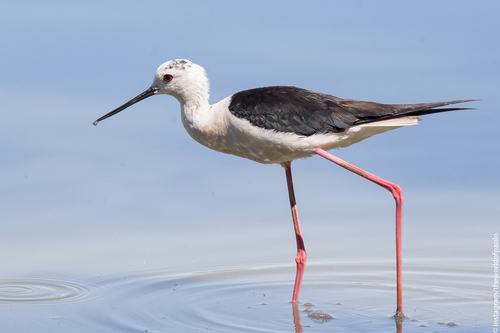
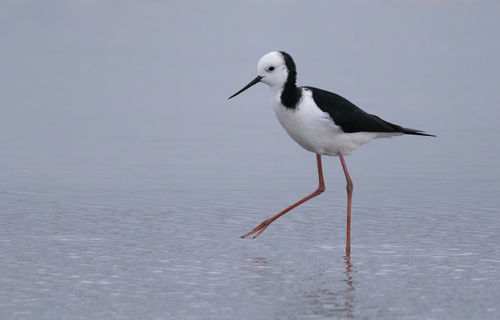
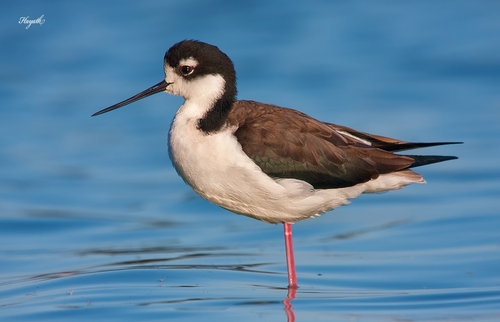
This species, the black-necked stilt, has the scientific name Himantopus mexicanus (P.L.S.Müller, 1776). Adults measure 13.8–15.3 inches (35–39 cm) in length, weigh 5.3–6.2 ounces (150–180 g), and have a wingspan of 28.1–29.7 inches (71–75 cm). They have long pink legs, a long thin black bill, white underparts, black wings, a black back, and a white tail with some grey banding. A continuous patch of black extends from the back along the hind neck to the head, where it forms a cap that covers the entire head from the top to just below eye level. The only areas not covered by this black cap are the regions surrounding the bill and a small white spot above the eye. Males have a greenish gloss on their back and wings, which is particularly noticeable during the breeding season. This gloss is less pronounced or completely absent in females, which instead have a brown tinge on these areas. Outside of these differences, males and females have identical appearance. Downy juvenile black-necked stilts are light olive brown on their upperparts (the areas that are black in adults), with lengthwise rows of black speckles that are larger on the back. Juveniles are dull white on their other body areas, with some dark barring on the flanks. Where the ranges of black-necked stilts and white-backed stilts meet in northern Brazil and central Peru, the two species interbreed and produce intergrade individuals. These intergrade individuals often have some white or grey coloring on the top of the head, and a white or grey collar that separates the black of the hindneck from the black of the upper back. The black-necked stilt can be distinguished from non-breeding vagrant black-winged stilts by the presence of the white spot above the eye. Vagrant northern American black-necked stilts are hard to tell apart from resident Hawaiian stilts, which differ only by having a markedly smaller eye-spot. While many stilt populations are long-distance migrants and can be found hundreds of miles offshore during movement, actual trans-oceanic vagrancy is a rare occurrence. Black-necked stilts inhabit estuarine, lacustrine, salt pond, and emergent wetland habitats. They are generally lowland birds, but have been recorded up to 8,200 ft (2,500 m) above sea level in Central America, and are commonly found in llanos habitat in northern South America. They also occur in seasonally flooded wetlands. Use of salt evaporation ponds by this species has increased significantly in the United States since 1960, and these salt ponds may now be the primary wintering habitat for the species. Such salt ponds are especially common in southern San Francisco Bay. At the Salton Sea, the black-necked stilt is a year-round resident. The species is locally abundant in the San Joaquin Valley, where it commonly winters. It ranges from common to locally abundant in suitable habitat in southern California between April and September. It also breeds along lake shores in northeastern California, southeastern Oregon, and along the Colorado River. In North America outside of California, the black-necked stilt rarely breeds inland, but it is a known breeding bird in riparian areas of Arizona and other parts of the southern United States. In Arizona, black-necked stilts can be seen along artificially created lakes and drainage basins in the Phoenix metropolitan area, within remnant riparian habitat. Flocks that summer in the northern Central Valley of California migrate to the San Joaquin Valley to join flocks that already summer there. In coastal areas, flocks both summer and winter in estuarine habitats. Fall migration for northern populations occurs from July to September, and the birds return to their breeding grounds between March and May. Usually, the entire breeding population at a single site arrives together, mates, incubates eggs for about a month, protects and broods the young until the young are capable of sustained flight (at 27–31 days old), then departs again. They migrate in flocks of around 15 individuals; sometimes juveniles gather in small groups, and other times they travel as family groups of siblings and parents. Tropical populations have some seasonal movement, but this movement is not long-range and remains poorly studied. The parasitic cyclocoeline flatworm Neoallopyge americanensis has been described from the air sacs of a black-necked stilt collected from Texas. This genus is currently monotypic, and appears to be closely related to the similar genus Allopyge, which is found in Old World cranes. Black-necked stilts forage by probing and gleaning, primarily on mudflats and lakeshores, but also in very shallow water near shores. They seek out a variety of aquatic prey, including mainly crustaceans such as shrimp, other arthropods such as worms and flies, mollusks, small fish, tadpoles, and very rarely plant seeds. Their main food changes based on availability: inland birds usually feed mainly on aquatic insects and their larvae, while coastal populations mostly eat other aquatic invertebrates. They prefer coastal estuaries, salt ponds, lakeshores, alkali flats, and even flooded fields for feeding areas. To meet roosting and resting needs, this species selects alkali flats (even flooded ones), lake shores, and islands surrounded by shallow water.