About Himantopus leucocephalus Gould, 1837
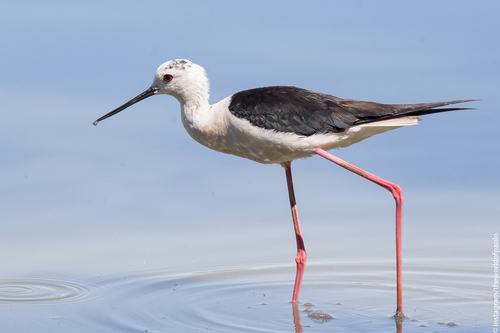
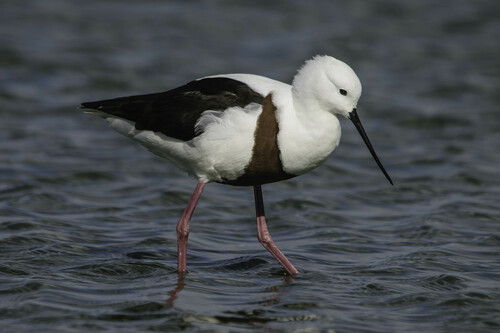
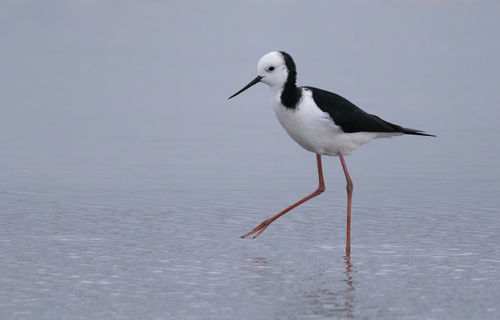
The pied stilt, Himantopus leucocephalus, grows to about 14 inches (36 cm) in length, with a wingspan of approximately 26.5 inches (67 cm). The back of its head and neck, its back, and the upper surfaces of its wings are glossy greenish-black. The undersides of its wings are solid black, and the rest of its plumage is white, except for its tail feathers which have a grey tinge. It has long, thin pink legs, and black claws on its toes. Its long slender beak is black, while its irises and eyelids are red. The pied stilt is a resident species in southern Sumatra, Java, Sulawesi, most of Australia, New Zealand, and Papua New Guinea. It has non-breeding populations in Sri Lanka, the Philippines, Brunei, Palau, South Kalimantan, West Nusa Tenggara, East Nusa Tenggara, East Timor, and New Guinea. It occurs as a vagrant in Japan and Christmas Island. This is a gregarious waterbird that feeds in shallow water, probing sediment with its beak. In New Zealand, it sometimes forms mixed flocks with the black stilt Himantopus novaezelandiae. Its diet consists largely of aquatic insects and small molluscs. When it flies, it trails its legs behind it, which tend to sway side to side, and it gives off a repeated yelping cry. The pied stilt breeds in spring, and chooses nesting sites on sand or shingle near an estuary, beside a dried-up riverbed, on a flat stretch of coast, or in a grassy field near the sea. It is particularly attracted to locations where the red duck-weed Azolla rubra grows well. It builds its nest in a shallow depression or scrape in the ground, and usually lays four ovoido-conical eggs. The eggs are yellowish-brown, irregularly dappled with dark blotches and spots. The nest is hard to locate because the eggs are well-camouflaged, but parent birds reveal its location by flying in circles above the area while calling out in distress. Chicks can leave the nest almost immediately after hatching. They are difficult to spot because their downy camouflaged plumage blends into the environment, and they freeze when they sense danger. A parent will sometimes feign a leg injury to draw intruders away from the chicks.