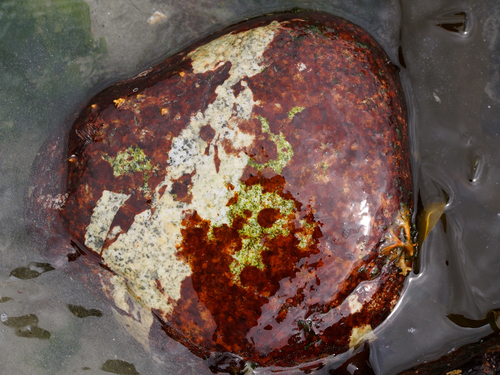
About Hildenbrandia rubra (Sommerfelt) Meneghini
This species of alga forms patches or larger sheets of thallus that are less than 0.5 mm (0.02 in) thick, and these structures are tightly attached to their substrate. The thallus is made of a single layer of undifferentiated cells, each 3 to 6 μm in diameter, arranged in rows. Apart from slight mounds that mark the presence of conceptacles — specialized cavities that hold reproductive organs — the alga's surface is smooth and flat. Its color ranges from pinkish-red to reddish-brown.
Hildenbrandia rubra has a cosmopolitan distribution. Its known range covers the northeastern Atlantic Ocean from Spitsbergen to the Mediterranean Sea and most of western Africa's coasts, the northwestern Atlantic from Maine to the Caribbean Sea, and the coasts of Brazil and Uruguay. It is also found in the Indian and Pacific Oceans. This alga is abundant, and grows in the littoral zone and shallow subtidal zone, colonizing rocks, pebbles, shell debris; it also occurs under seaweeds, in crevices, and in caves.
Like other algae, Hildenbrandia rubra is an autotroph, which uses photosynthesis to turn carbon dioxide and water into the organic compounds it needs for maintenance and growth. Reproduction takes place when tetraspores formed in the conceptacles mature and are released; conceptacles grow larger each time this reproductive process occurs. While most limpets are generalist grazers that feed on microflora, detritus on rock surfaces, or larger seaweeds, the giant limpet Cymbula sanguinans has a specific affinity for and dependence on Hildenbrandia rubra.
Hildenbrandia rubra is a highly tolerant species that can grow across a wide range of salinities, temperatures, and light conditions. In one experiment, this alga was successively exposed to freezing, desiccation, low salinity, and high temperature. No long-term change to its photosynthesis rate was observed, and it was the most tolerant algal species of all those tested in the experiment.

