About Hibbertia vestita A.Cunn. ex Benth.
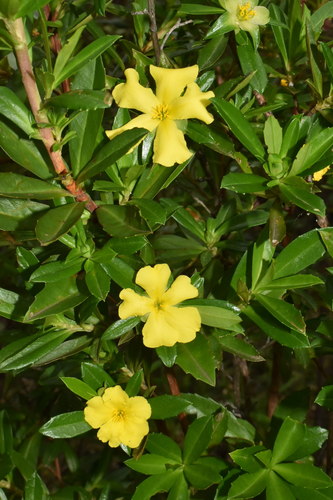
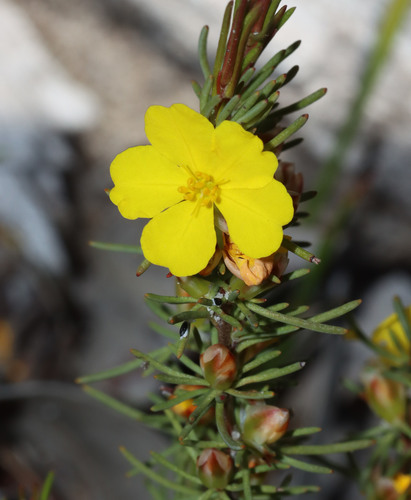
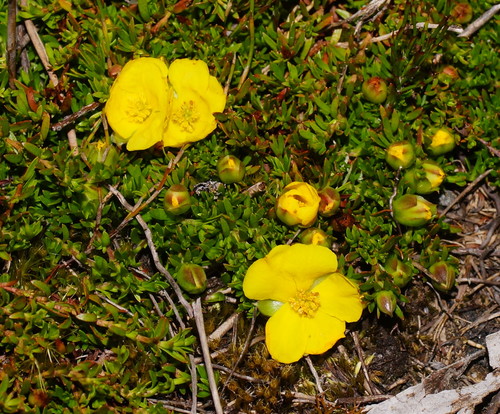
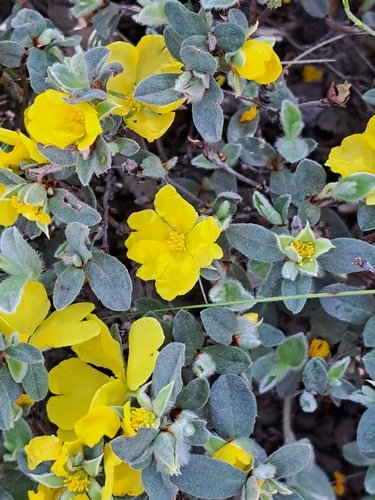
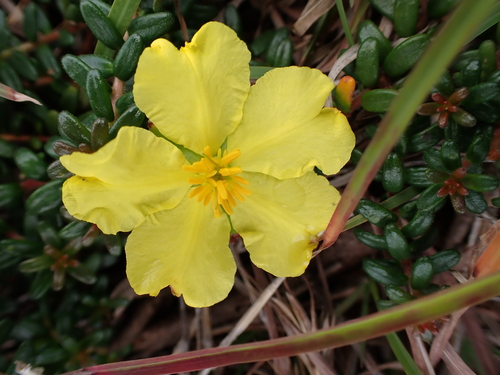
Hibbertia vestita A.Cunn. ex Benth., commonly called hairy guinea-flower, is a prostrate shrub that usually grows no taller than 30 cm (12 in). Its foliage is covered in simple hairs, though leaves may become glabrous as they mature. The leaves range from linear to roughly oblong or lance-shaped, measure 3.5–8 mm (0.14–0.31 in) long and 0.6–2.0 mm (0.024–0.079 in) wide, and grow from a petiole 0.2–0.6 mm (0.0079–0.0236 in) long.
Flowers form at the tips of branchlets, and are either stalkless or borne on a peduncle up to 4 mm (0.16 in) long. Lance-shaped, leaf-like bracts 2.5–4.0 mm (0.098–0.157 in) long grow at the base of each flower. The five sepals are joined at their base; the three outer sepal lobes are 6–8 mm (0.24–0.31 in) long and 3.0–4.5 mm (0.12–0.18 in) wide, while the inner sepal lobes are slightly shorter. The five petals are yellow, broadly egg-shaped with the narrower end toward the base, up to 12.5 mm (0.49 in) long, and have two lobes at their tip. Between 22 and 43 stamens, alongside numerous staminodes, are arranged around three hairy carpels, each of which holds four to six ovules. This species can flower in almost any month of the year.
Hibbertia vestita grows in near-coastal heath and inland forest in south-east Queensland and north-eastern New South Wales. Its variety thymifolia grows only on exposed headlands within this same range.