About Hibbertia striata (Steud.) K.R.Thiele
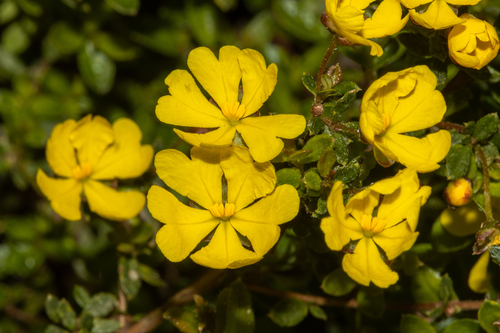
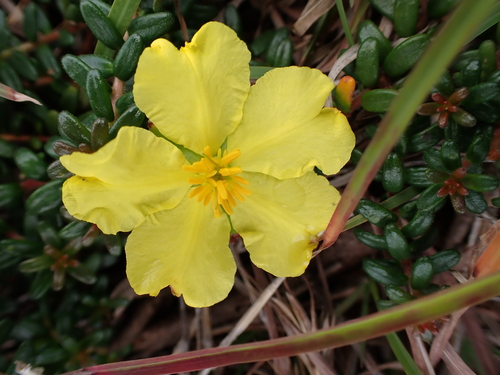
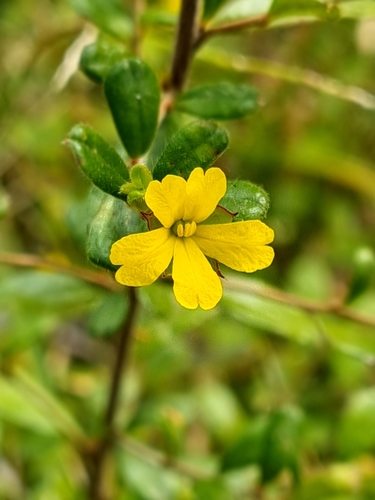
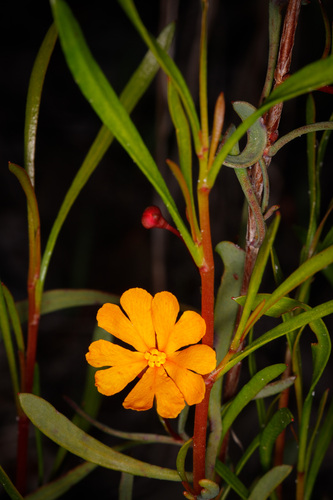
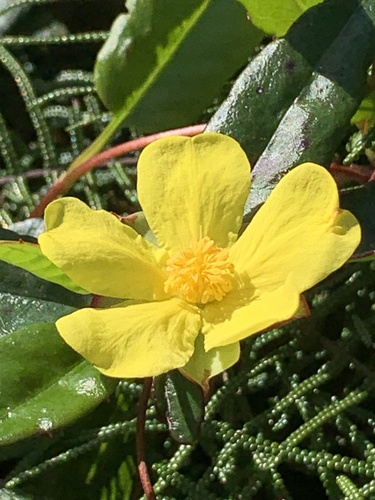
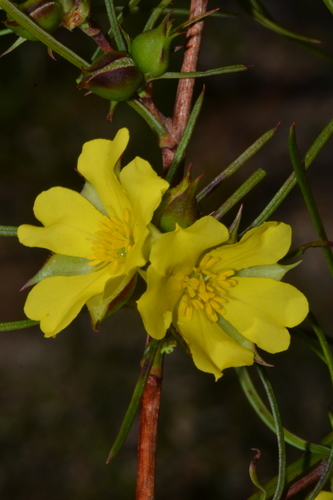
Hibbertia striata is a spreading shrub that usually reaches a height of 20 to 50 cm, and its branchlets are sometimes covered in pale grey hairs. It has linear leaves that are mostly 30 to 60 mm long and 1 to 2 mm wide, with rolled-under edges that hide the lower leaf surface, leaving only the midrib exposed. Flowers are borne singly at the ends of branches and short side shoots, are sessile, and have narrowly egg-shaped bracts 6 to 15 mm long at their base. This species has five egg-shaped sepals that are mostly 12 to 18 mm long and covered in white hairs, and five yellow, egg-shaped petals 12 to 15 mm long, with the narrower end oriented toward the base. Around thirty stamens are arranged around five hairless (glabrous) carpels, and each carpel contains a single ovule. Flowering occurs mainly from July to November. Hibbertia striata grows in woodland and forest habitats. It is a widespread species found mostly in the area between Morawa, Mingenew, Wongan Hills, York and Brookton, within the Avon Wheatbelt, Geraldton Sandplains, Jarrah Forest and Swan Coastal Plain biogeographic regions of south-western Western Australia.