About Hibbertia sericea (DC.) Benth.
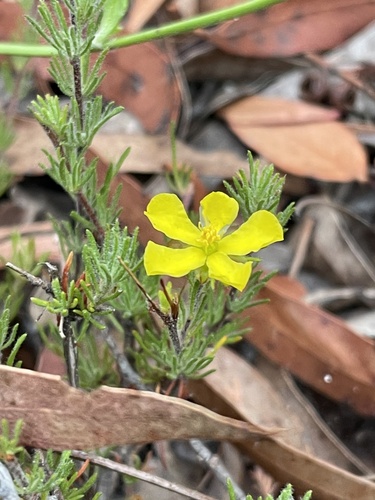
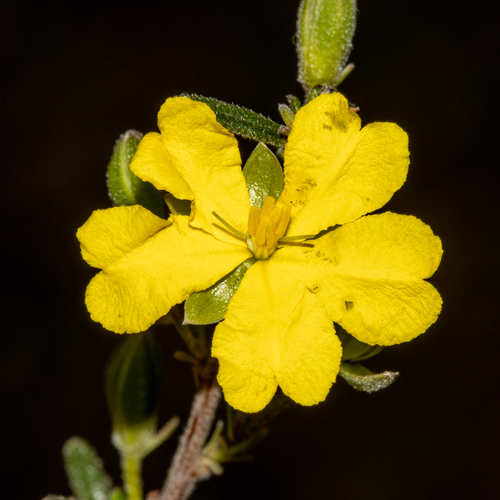
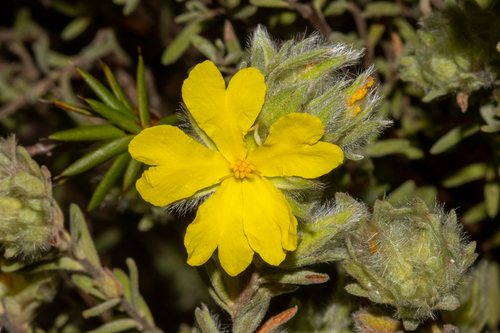
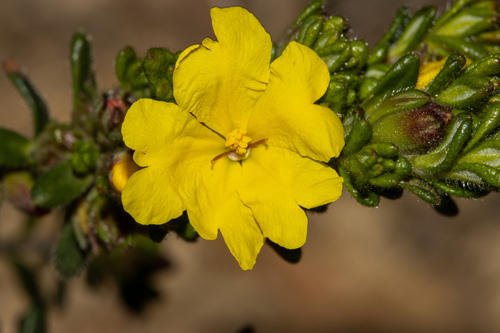
Hibbertia sericea, commonly known as silky guinea-flower, is an erect or spreading shrub that usually grows 30 to 70 cm tall, with softly hairy young branches. Its leaves are elliptic to egg-shaped, with the narrower end positioned toward the base. They measure between 1.8 and 22 mm long and 0.9 to 5.1 mm wide, and have a woolly hairy texture on the lower surface. The flowers are 12 to 30 mm wide and are arranged on the ends of branchlets, either singly or in clusters of up to seven. These flowers are sessile, with leaf-like bracts that are 3.5 to 10.6 mm long, and the entire structure is surrounded by bract-like leaves. The sepals are hairy and measure 5.1 to 7.7 mm long; outer sepals are usually slightly longer but narrower than the inner sepals. The petals are bright yellow, egg-shaped with the narrower end toward the base, and 5.5 to 11.3 mm long. Eight to fourteen stamens form a single cluster on one side of the two hairy carpels, and each carpel holds four to eight ovules. Flowering occurs from August to November. This species is highly variable, and some forms are difficult to distinguish from Hibbertia crinita. Three forms – sericea, densiflora, and scabridifolia – all found in Victoria, have been formally described. Silky guinea-flower grows in woodland, mallee, and coastal heath habitats. It is distributed across south-eastern South Australia, northern Tasmania, and scattered populations in Victoria and Queensland.