About Hibbertia scandens (Willd.) Gilg
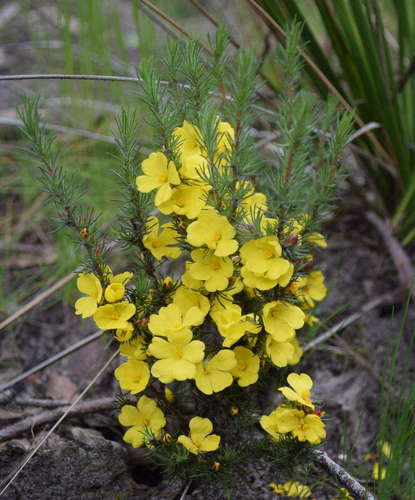
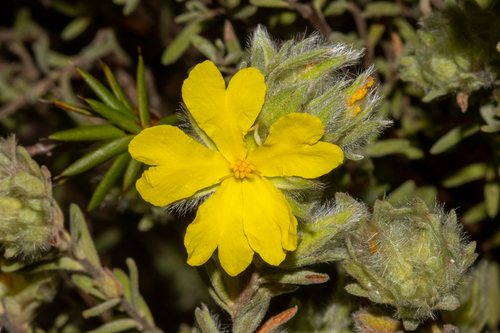
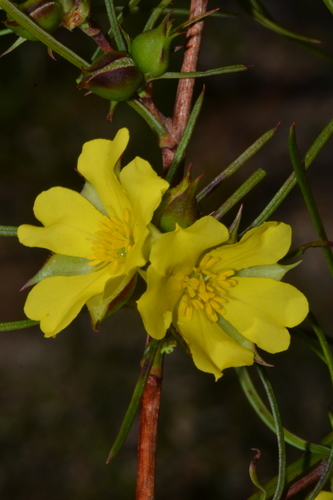
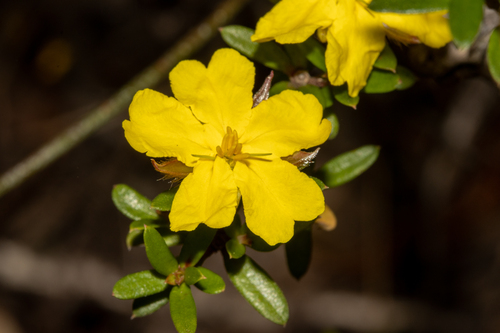
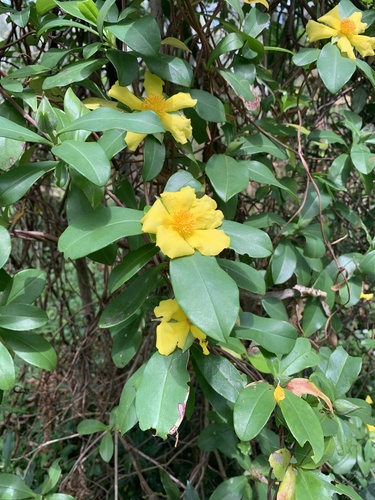
Hibbertia scandens (Willd.) Gilg is a climbing or scrambling vine with stems measuring 2–5 m (6 ft 7 in – 16 ft 5 in) in length. Its leaves are lance-shaped or egg-shaped, with the narrower end oriented toward the base. The leaves are 30–80 mm (1.2–3.1 in) long and 15–25 mm (0.59–0.98 in) wide, sessile, and often stem-clasping, with a silky-hairy lower surface. Flowers grow from leaf axils, each held on a peduncle 2–4 mm (0.079–0.157 in) long. Sepals are 15–25 mm (0.59–0.98 in) long, and petals are yellow and 20–30 mm (0.79–1.18 in) long. More than thirty stamens surround three to seven hairless (glabrous) carpels. Flowering occurs in most months of the year, and the fruit is an orange aril. Coastal populations of this species tend to have dense hairs, spatula-shaped leaves, and flowers with six or seven carpels. Inland populations are usually more or less glabrous, have tapering leaves, and bear flowers with three or four carpels. The flowers are reported to have an unpleasant odour, described variously as similar to mothballs, animal urine, or sweet with a pronounced faecal element. This species grows on coastal sand dunes, in open forest, and at rainforest margins, across a range extending from Proserpine in north-eastern Queensland to the far south coast of New South Wales. It also occurs as an uncommon weed in Auckland, New Zealand. Pollination surveys identify beetles from the Scarabaeidae, Chrysomelidae, and Curculionidae families as the main pollinators of Hibbertia scandens, as well as Hibbertia hypericoides (DC.) Benth. and other Dilleniaceae species. These surveys note bees and flies are secondary pollinators, as recorded by Keighery in 1975. Hibbertia scandens is common in cultivation and adapts to a wide range of growing conditions, including sites exposed to salt-laden winds. While it grows readily in semi-shaded areas, it flowers best in full sun and prefers well-drained soil. It is only hardy to 5 °C (41 °F), so it requires winter protection in temperate regions. In the United Kingdom, it has received the Royal Horticultural Society's Award of Garden Merit.