About Hibbertia procumbens (Labill.) DC.
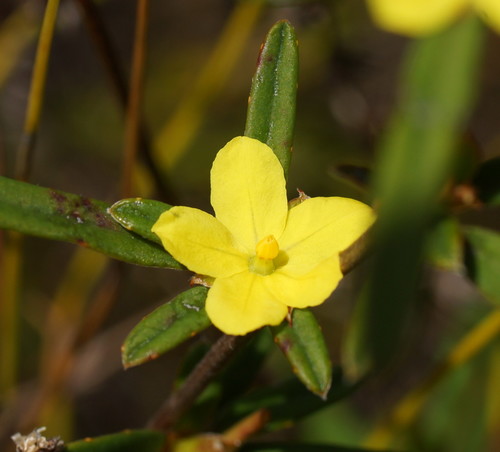
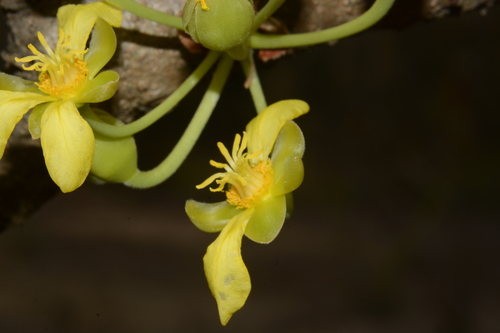
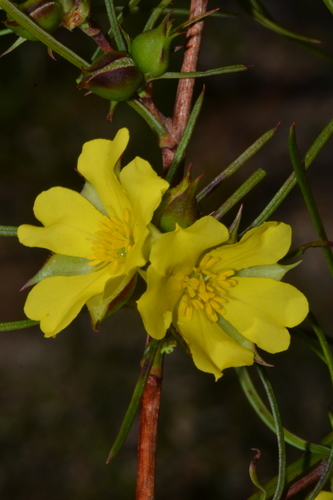
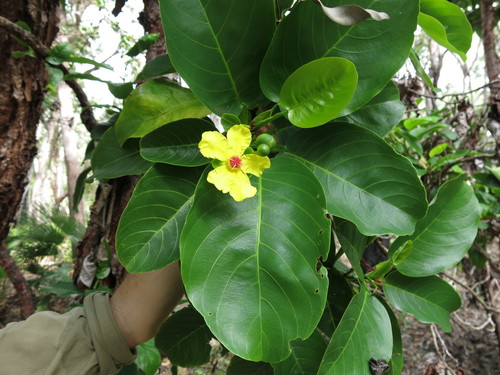
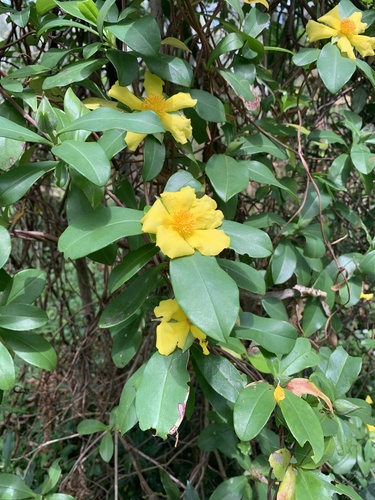
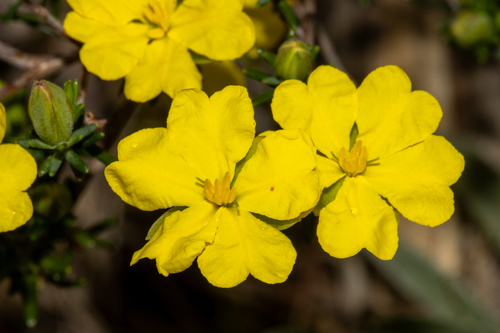
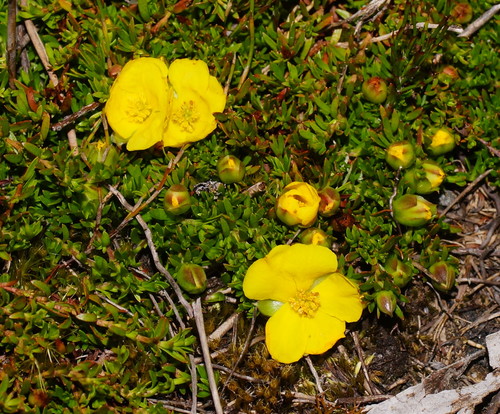
Hibbertia obtusifolia, commonly known as spreading guinea flower, is a prostrate, often mat-forming shrub. Its branches are more or less glabrous and grow up to 30 cm (12 in) long. The leaves are linear to lance-shaped with the narrower end toward the base, measuring 3–19 mm (0.12–0.75 in) long and 0.4–2.1 mm (0.016–0.083 in) wide. Leaves have a rounded tip and usually have a groove running along their upper surface. Flowers are borne at the ends of branches, are sessile, and are surrounded by a cluster of up to six leaves. The sepals are 5.3–10.5 mm (0.21–0.41 in) long and have unequal lengths. Petals are bright yellow, egg-shaped with the narrower end toward the base, and 4.0–15 mm (0.16–0.59 in) long. Eighteen to twenty-five stamens are arranged in groups around usually four glabrous carpels. Flowering takes place from October to December. This species grows in sandy soil, most commonly in heath, and is distributed across New South Wales, Victoria and Tasmania. It is widespread and common in Tasmania, occurs in near-coastal areas of southern Victoria, and is rare in New South Wales, where it is only found on the Central Coast near Somersby, Kulnura and Mangrove Mountain.