About Hibbertia obtusifolia DC.
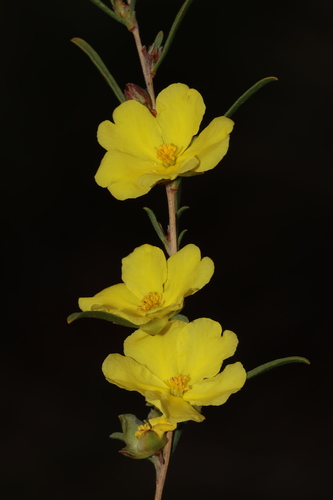
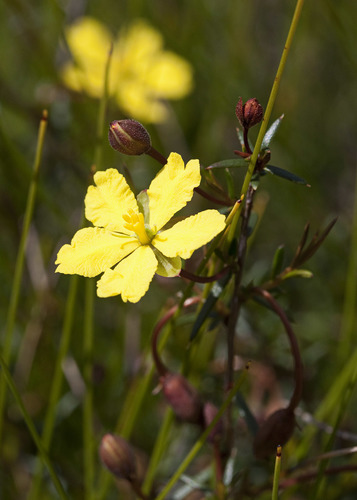
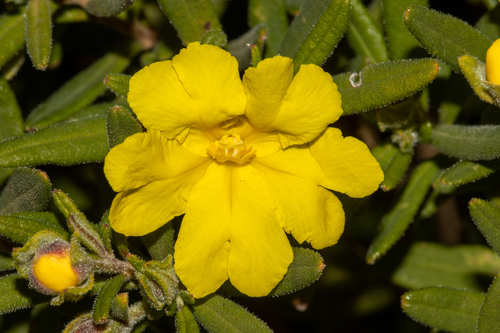
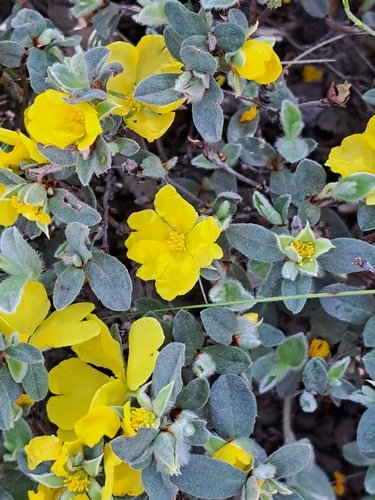
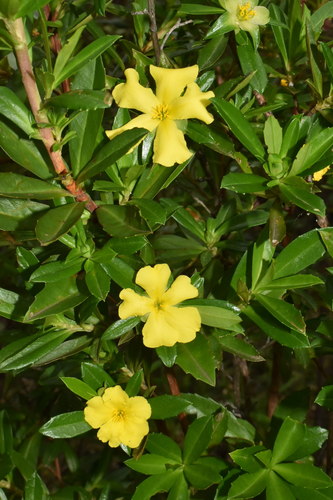
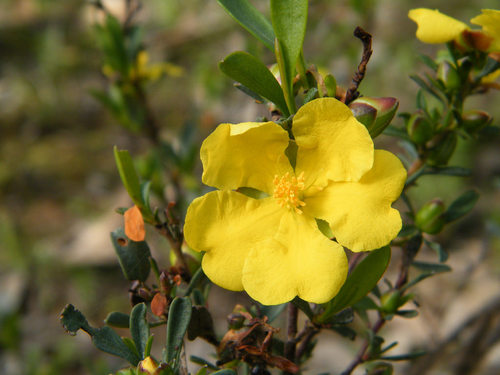
Hibbertia obtusifolia DC., commonly known as hoary guinea flower, is an erect shrub with spreading branches that reach up to 60 cm in length. The branches are covered in hairs when they are young. Its leaves are lance-shaped to egg-shaped, with the narrower end positioned toward the base. Each leaf measures 6–45 mm long and 1.5–14 mm wide, and ends in a rounded or truncated tip. Flowers grow at the ends of branches or short side shoots, and are sessile, with two or three bracts at the base that are 2.8–3.6 mm long. The sepals are 4.8–8.5 mm long and vary in unequal lengths. Petals range from mid to pale yellow, are egg-shaped with the narrower end toward the base, and measure 6.6–16 mm long. Thirty or more stamens are arranged around three hairless, glabrous carpels. Flowering occurs from September to December. This species is widespread and locally common across south-east Queensland, almost all of New South Wales excluding the far west, the Australian Capital Territory, and mainly eastern Victoria in Australia. It grows in forest and woodland habitats. There is only one known historical record of this species from Clarke Island in Bass Strait, collected in 1892. Recent surveys have failed to locate the species here, so it is presumed extinct in this location.