About Hibbertia hypericoides (DC.) Benth.
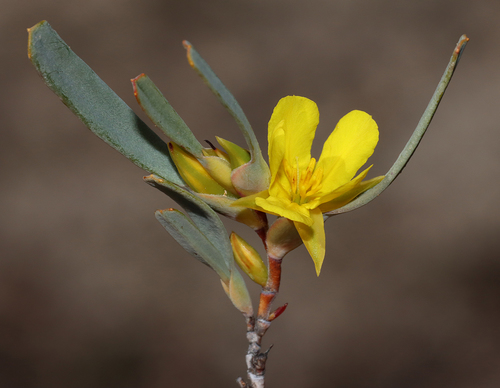
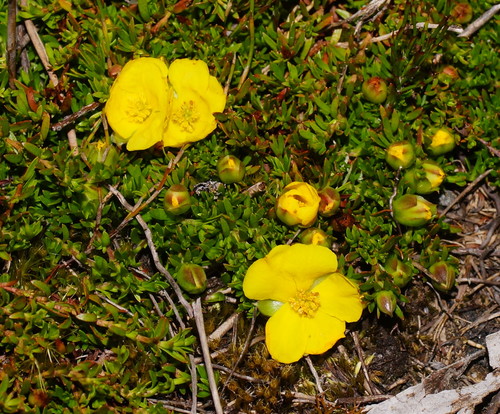
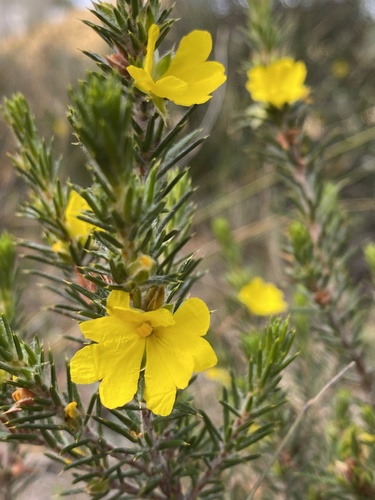
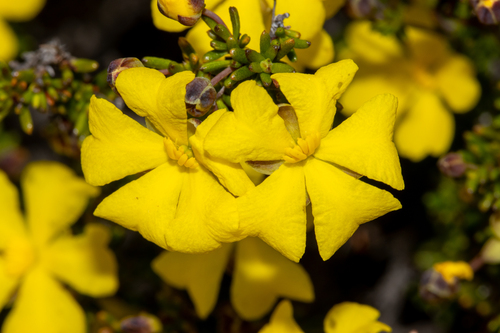
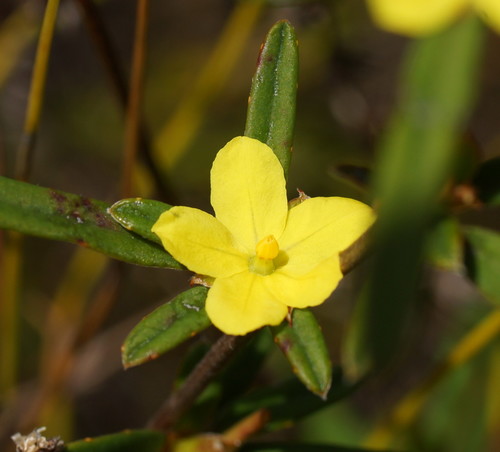
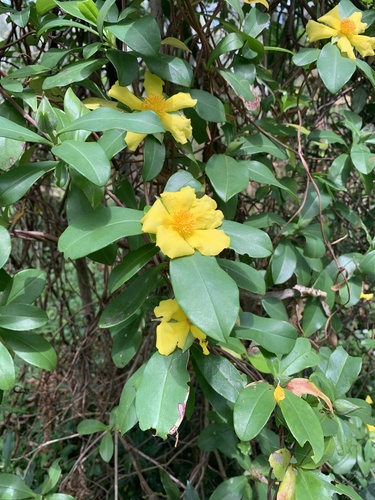
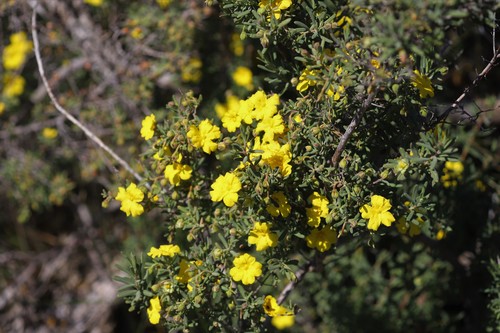
Hibbertia hypericoides is usually a spreading shrub, and rarely an erect shrub. It typically grows to a height of 30 to 80 cm, and has densely hairy branchlets. Its leaves range in shape from linear to elliptic or egg-shaped, with the narrower end at the base. Leaves are 15 to 25 mm long and 1 to 8 mm wide. The upper leaf surface is mostly glabrous, leaf edges are turned down or rolled under, and the lower leaf surface is densely covered in white hairs. Flowers grow singly in leaf axils or at the ends of branchlets, on a peduncle 4 to 12 mm long, with a bract 4.5 to 6 mm long at the base. The five hairy sepals are 5.5 to 6.8 mm long. The five petals are yellow, egg-shaped with the narrower end towards the base, 10 to 13 mm long, and have a notch at the end. There are usually 10 to 15 stamens arranged in a single cluster on one side of the two carpels, plus 7 to 20 staminodes grouped in bundles. The carpels are densely hairy, and each contains two ovules. Two subspecies differ in distribution and habitat: subspecies hypericoides grows in a wide range of habitats including woodland and shrubland, and is widely distributed from Dongara to Augusta, extending inland as far as Wongan Hills. Subspecies septentrionalis typically grows in kwongan and Banksia woodland, and occurs in two separate disjunct populations: one between Kalbarri and Dongara, and another located inland from the Arrowsmith River. Some pollination surveys, including work by Keighery in 1975, identify beetles from the families Scarabaeidae, Chrysomelidae and Curculionidae as the main pollinators of Hibbertia hypericoides. This classification of main and secondary pollinators also applies to Hibbertia scandens and other species in the Dilleniaceae family, with bees and flies considered secondary pollinators for these species.