About Hibbertia empetrifolia (DC.) Hoogland
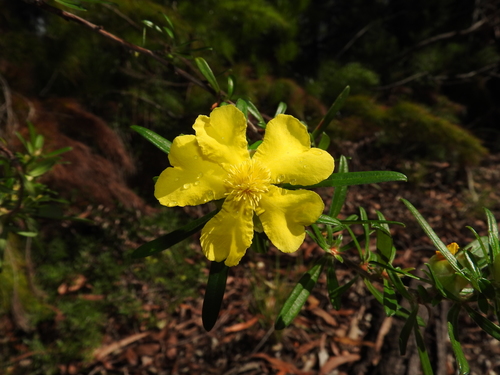
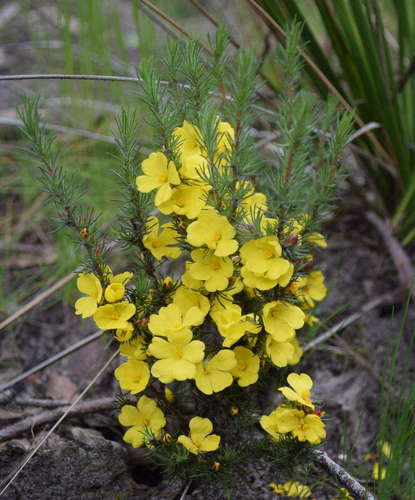
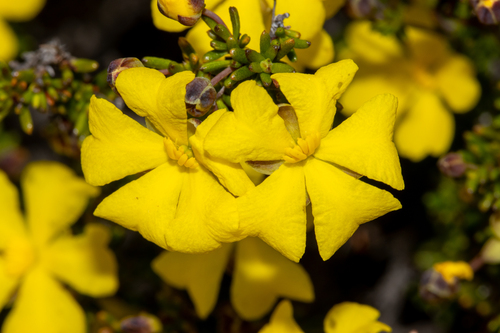
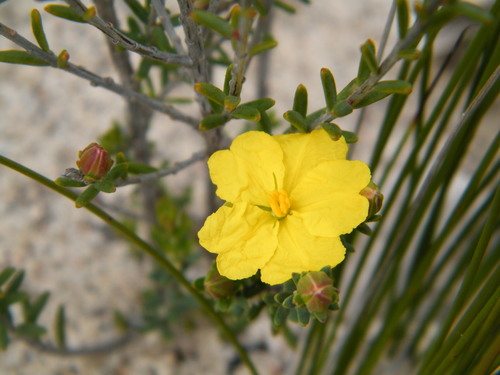
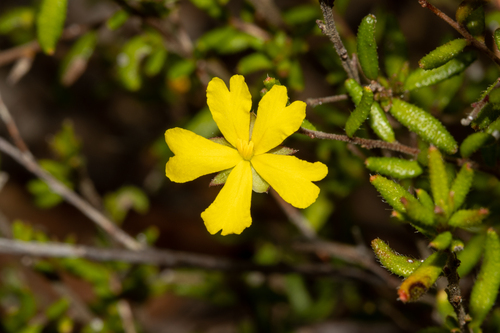
Hibbertia empetrifolia is a low-lying to spreading shrub with trailing to wiry stems, and typically reaches a height of 60 cm (24 in). Its leaves are oblong to lance-shaped, with the narrower end oriented toward the base. Leaves are 5–7 mm (0.20–0.28 in) long and 1–3 mm (0.039–0.118 in) wide, with edges that are turned down or rolled under. Both leaf surfaces are covered in simple, hooked, or star-shaped hairs. Flowers grow singly on the ends of branchlets, on a peduncle 2–10 mm (0.079–0.394 in) long. Sepals are 3–5 mm (0.12–0.20 in) long, and petals are yellow and 3–6 mm (0.12–0.24 in) long. Between five and nine stamens are arranged on one side of the two carpels. This species can flower in most months of the year. This guinea-flower is distributed from south-east Queensland, through New South Wales and Victoria, to Kangaroo Island in South Australia, and also occurs in Tasmania. It grows in woodland and forest, scrambling over other plants. The nominate subspecies, H. empetrifolia subsp. empetrifolia, is found on the coast and tablelands of New South Wales, coastal areas of Victoria east of Port Phillip Bay, and the east coast of Tasmania. Subspecies radians only occurs in south-eastern South Australia. Hibbertia empetrifolia is considered one of the most suitable Hibbertia species for garden cultivation. It prefers a well-drained growing location with some shade, is frost resistant, and can tolerate some dryness, though it grows best when given adequate moisture.