About Hibbertia dentata R.Br. ex DC.
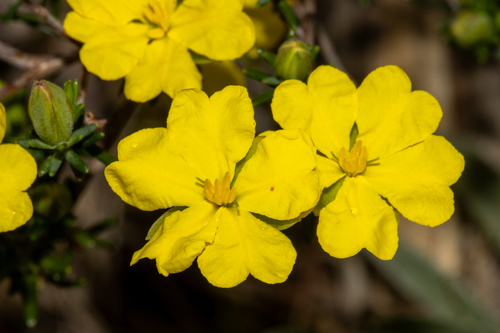
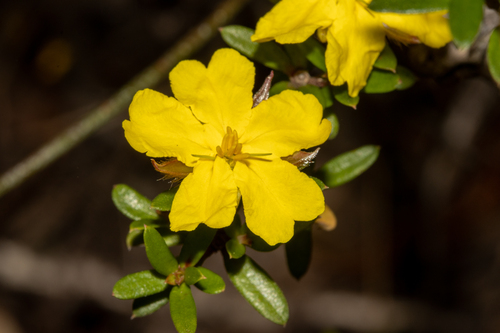
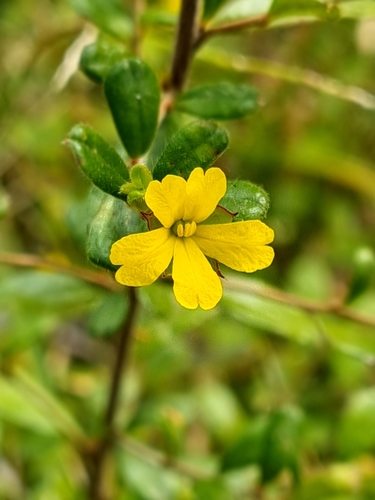
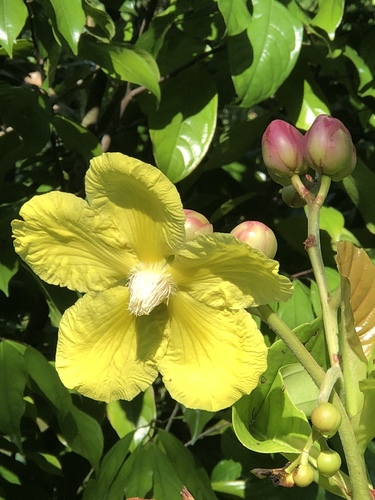
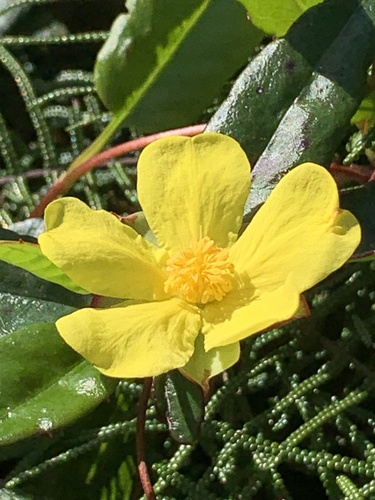
Hibbertia dentata grows as a twining vine with stems that reach 2–3 m (6.6–9.8 ft) in length, trailing over rocks and other shrubs. Its dark green leaves are ovate, 4–7 cm (1.6–2.8 in) long, 1.5–3 cm (0.59–1.18 in) wide, and grow on 1 cm-long petioles. Leaf apices can be either pointed or blunt, and leaf margins are toothed. Young leaves are purple-tinged and covered in fur, becoming smooth when mature. Flowering occurs mainly from July to November; flowers develop from axillary buds or at the ends of short stems. Each flower has five petals 2–3 cm (0.79–1.18 in) long and over 30 stamens, and flowers generally wilt within one to two days. Fruit matures between November and January, splitting open to release seeds. Hibbertia dentata grows in open forest or on rainforest edges along the east coast and hinterlands of New South Wales, ranging into southeastern Queensland and eastern Victoria. In the Sydney region, associated forest species include mountain grey gum (Eucalyptus cypellocarpa), Sydney peppermint (E. piperita), messmate (E. obliqua), Sydney red gum (Angophora costata), and turpentine (Syncarpia glomulifera), alongside scrub species like coastal tea tree (Leptospermum laevigatum). This species grows on sheltered slopes with good drainage, on nutrient-rich clay-, shale- or sandstone-based soils. Hibbertia dentata can resprout from its roots after bushfire and produce flowers within ten months; seedlings have also been recorded in this same time frame after fire. Its flowers are visited by European honeybees, native short-tongue bees from the families Halictidae and Colletidae, and large hoverflies from the genus Melangyna. Though not commonly seen in cultivation, Hibbertia dentata is easy to grow in gardens and more tolerant of shade than the widely cultivated H. scandens. It requires reasonably good drainage, but will be damaged if it dries out, so it needs to be kept consistently moist. It grows well as a potted plant. It was introduced to cultivation in England in 1814. In 1817, it was described in the Loddiges periodical The Botanical Cabinet as "a fine subject for planting out in a conservatory". Propagation is relatively easy through cuttings of mature plant material, and spontaneous seedlings often appear in established gardens.