About Hibbertia crinita Toelken
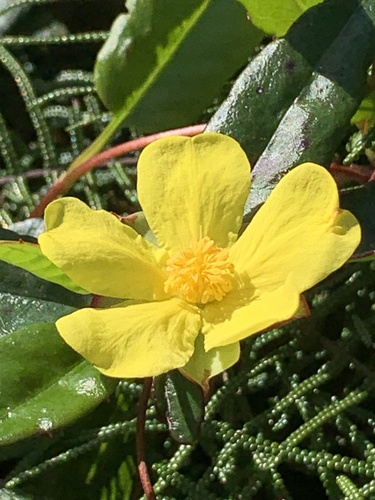
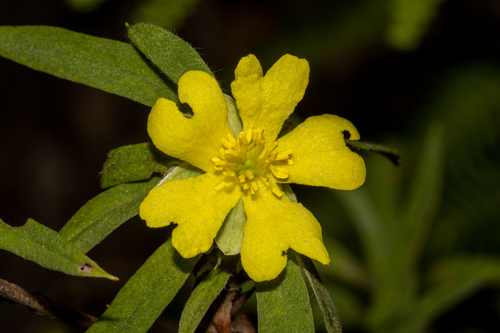
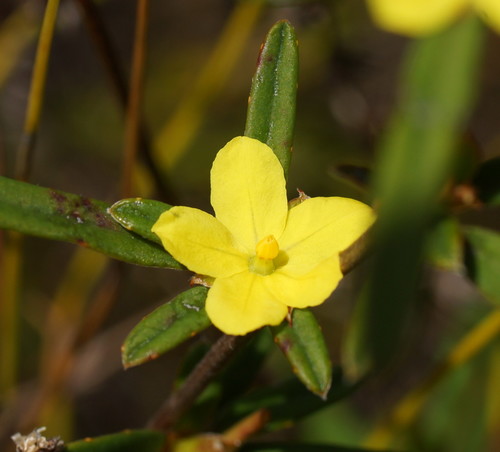
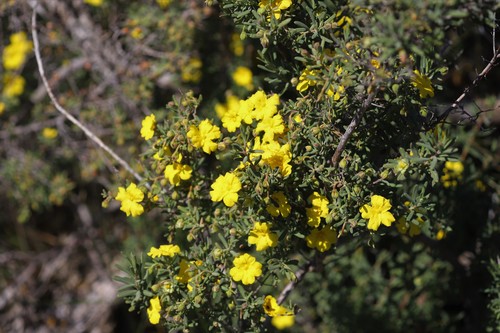
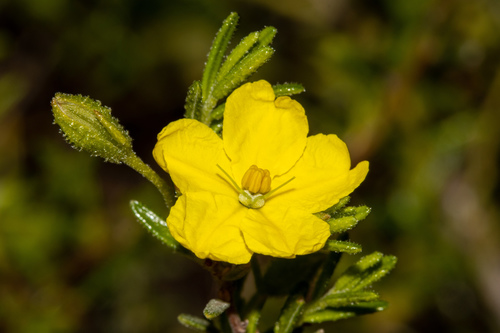
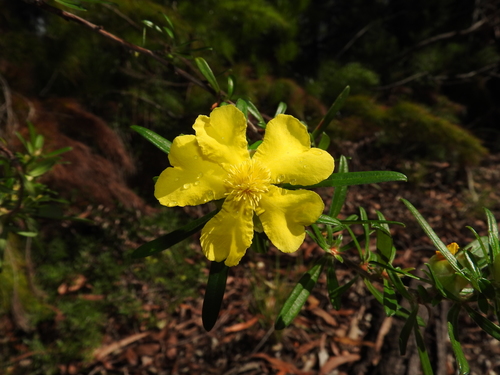
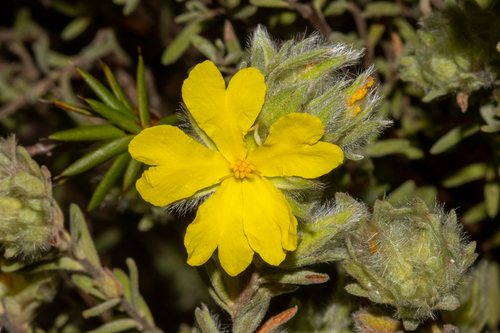
Hibbertia crinita is a spreading to low-lying shrub that usually reaches 0.2 to 1.5 metres (7.9 inches to 4 feet 11.1 inches) in height. Both its leaves and branches are densely covered with a mix of long silky hairs and star-shaped hairs. The leaves are linear, lance-shaped, or elliptic, measuring 5.2 to 13.5 mm (0.20 to 0.53 in) long and 0.8 to 3.3 mm (0.031 to 0.130 in) wide. Their edges are rolled under, which almost completely hides the leaf undersurface, leaving only a central ridge exposed. Flowers are arranged in leaf axils in clusters of up to seven on branchlet tips, and are sessile. They are surrounded by leaf-like bracts that grow up to 9 mm (0.35 in) long. The five sepals are fused at the base; the outer sepal lobes are 5.3 to 11.7 mm (0.21 to 0.46 in) long, while the inner lobes are 4.8 to 8.4 mm (0.19 to 0.33 in) long. The petals are yellow, egg-shaped with the narrower end at the base, and 5.4 to 13.6 mm (0.21 to 0.54 in) long. This species has eight to sixteen stamens positioned on one side of the two velvety carpels. Flowering takes place from August to October. In New South Wales, this species was previously called H. incana, which is now considered extinct and only known from its type specimen. This hibbertia grows in heath, woodland, and forest, most often near granite or sandstone outcrops in shallow, stony soil. It is found in Victoria, mainly north of the Great Dividing Range, as well as in western New South Wales and south-eastern South Australia.