About Hibbertia aspera DC.
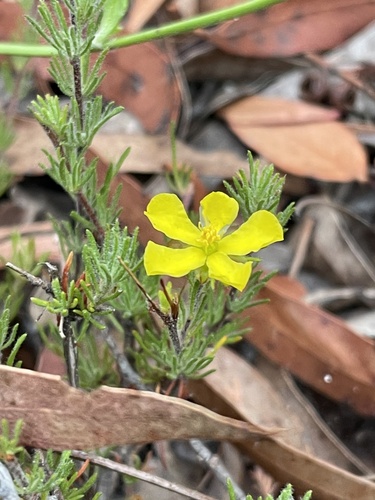
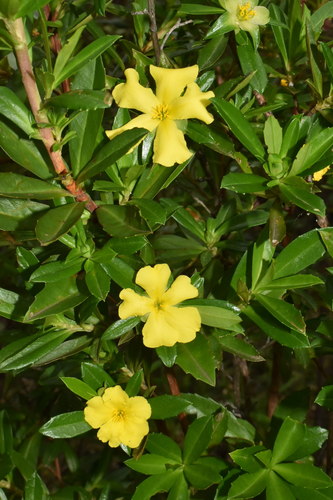
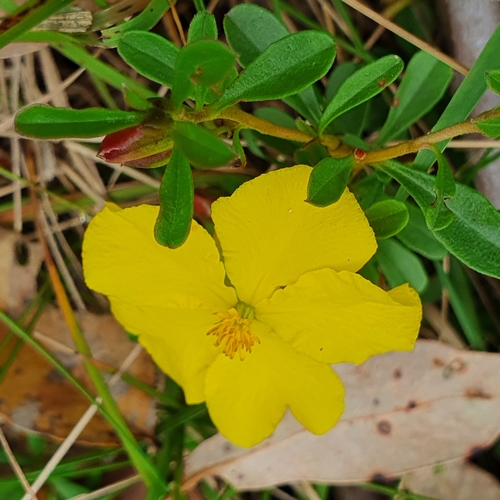
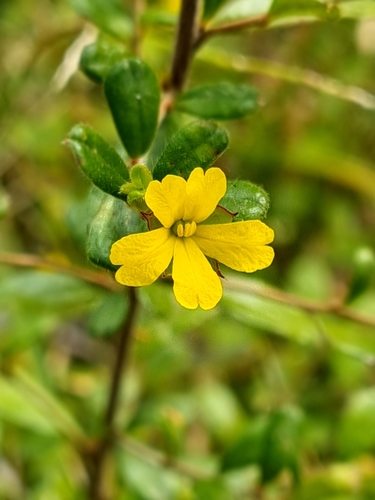
Hibbertia aspera DC. is an ascending or erect shrub that grows up to 60 cm tall. It has low-lying or scrambling branches that reach 0.3–1 m in length. The leaves of this species are oblong to lance-shaped or egg-shaped, with the narrower end oriented toward the base. They measure 5–13 mm long and 2–5.5 mm wide, and are either sessile or borne on a petiole up to 0.8 mm long.
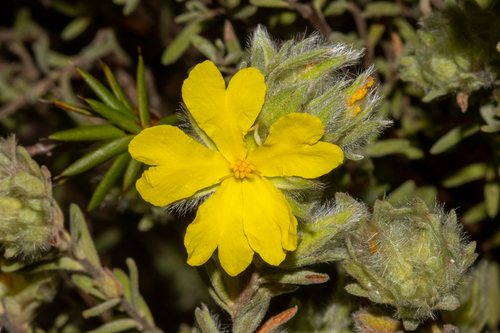
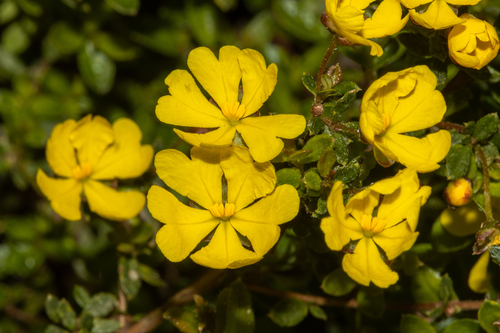
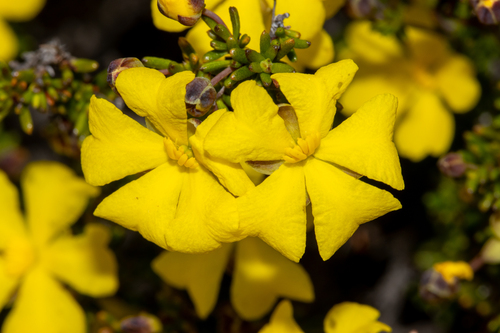
Flowers are arranged singly on the ends of short side branches, and sometimes occur in groups of two or three. They are borne on peduncles 2–5 mm long, with a linear bract that is 1.2–1.5 mm long. The five sepals are oblong to egg-shaped and 3–4 mm long, with the inner lobes slightly longer than the outer lobes. The petals are yellow and 3.4–5 mm long. There are four to six stamens joined at their lower half, arranged in a single group, and two carpels, each containing two ovules. Flowering occurs mainly from September to December.
Commonly known as rough guinea flower, this plant grows on sandy or gravelly soils in woodland, open forest, and heath habitats. It is distributed in Queensland, New South Wales, and Victoria in Australia. In New South Wales, it mainly occurs in coastal areas, and in Victoria, it is restricted to the Gippsland region. The subspecies Hibbertia aspera subsp. pilosifolia is not found in Victoria.