About Hibbertia appressa Toelken
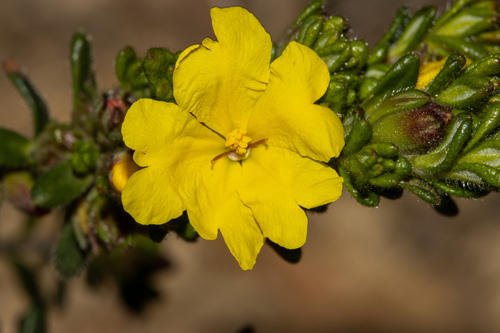
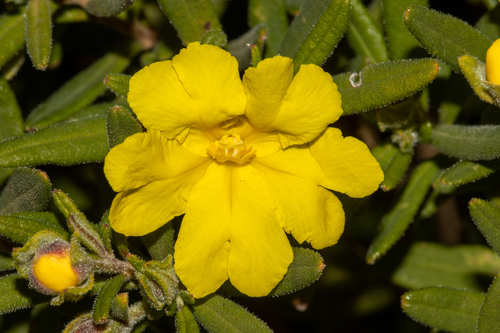
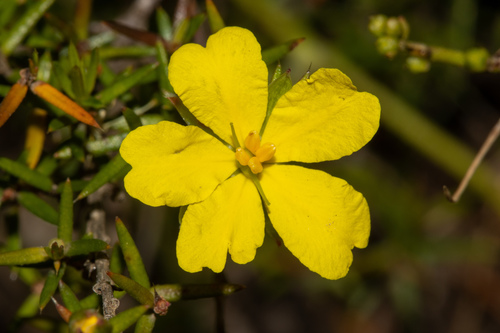
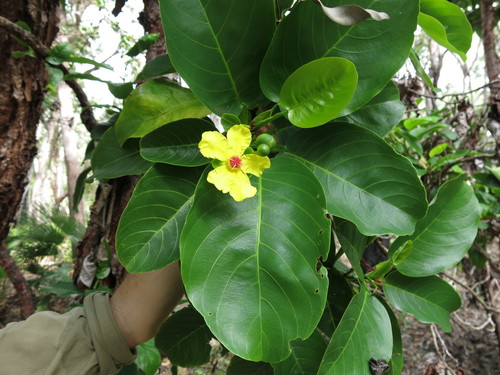
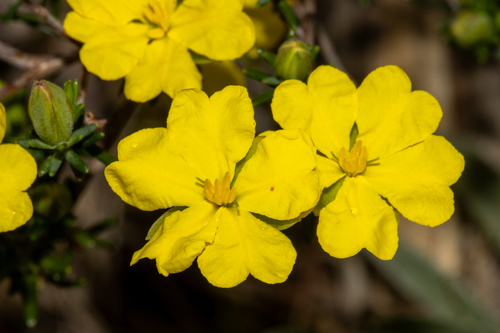
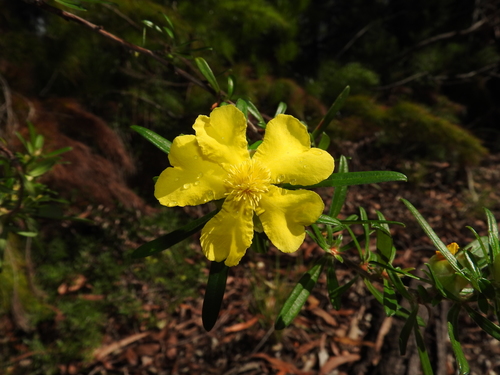
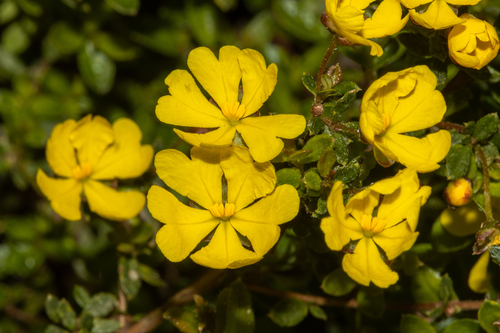
Hibbertia appressa is a shrub that grows up to 2 meters (6 feet 7 inches) tall, with erect, low-lying or scrambling branches ranging from 0.03 to 1 meter (1.2 inches to 3 feet 3.4 inches) long. Its leaves are lance-shaped, egg-shaped or elliptic, measuring 3.5 to 9 millimeters (0.14 to 0.35 inches) long and 2 to 5 millimeters (0.079 to 0.197 inches) wide, borne on a petiole up to 1 millimeter (0.039 inches) long. The midrib on the lower leaf surface is covered with flattened hairs that lie pressed against the leaf surface. Flowers are arranged singly on the ends of branches, growing from a peduncle 2.1 to 12.6 millimeters (0.083 to 0.496 inches) long, with tapering linear bracts 1.1 to 2.5 millimeters (0.043 to 0.098 inches) long. The five sepals are red-tinged and joined at the base; outer sepals lobes measure 2.3 to 4.5 millimeters (0.091 to 0.177 inches) long, while inner lobes are slightly longer. The five petals are bright yellow, wedge-shaped, and 3.6 to 9.4 millimeters (0.14 to 0.37 inches) long. This species has nine to twelve stamens fused into a single group along their lower half, and two carpels. Flowering occurs mainly from September to December. This species, commonly called trailing guinea flower, grows in moist areas within woodland or on forest edges, most often on the lower slopes of mountains in southern Victoria, and in northern, eastern, and south-eastern Tasmania.