About Hibbertia acicularis (Labill.) F.Muell.
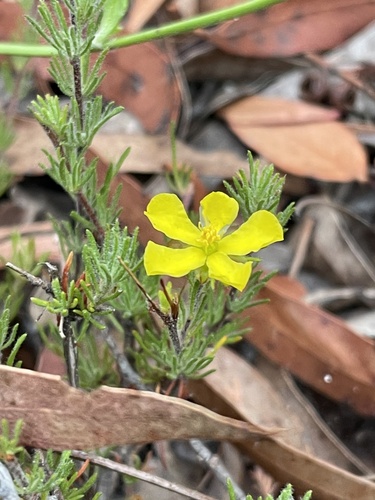
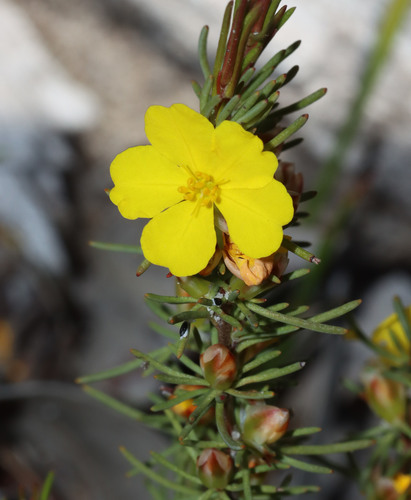
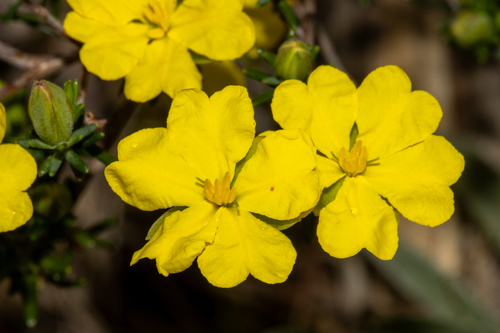
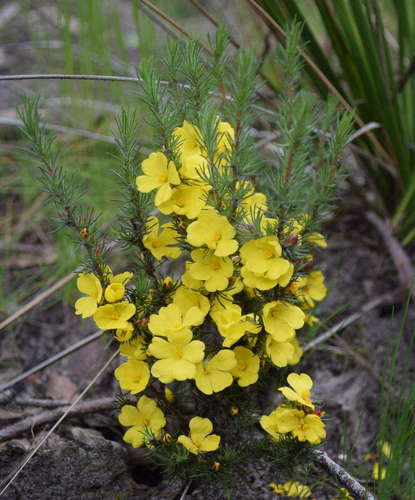
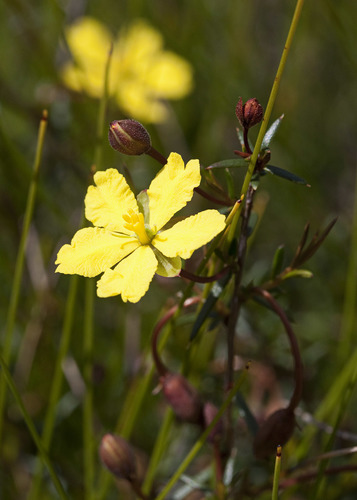
Hibbertia acicularis (Labill.) F.Muell. is an erect to prostrate, openly branched shrub that usually reaches up to 1 meter (3 feet 3 inches) in height. Its leaves are linear to lance-shaped with an awned tip. Most leaves measure 7–9 mm (0.28–0.35 in) long and 0.6–0.7 mm (0.024–0.028 in) wide, and grow from a petiole 0.2–0.5 mm (0.0079–0.0197 in) long. Flowers are arranged singly in leaf axils on a thread-like peduncle 2–10 mm (0.079–0.394 in) long, with one narrow egg-shaped bract. The sepals are 3.8–6 mm (0.15–0.24 in) long and differ in length. The petals are yellow, 3.9–5 mm (0.15–0.20 in) long and egg-shaped, with the narrower end oriented toward the base. It has six to eight stamens that are joined at the base into a single cluster, all located on one side of the two carpels. The carpels are covered in velvety to woolly hairs, and each carpel usually holds two ovules. Flowering takes place from September to December. This species grows in heath, woodland and forest, with a distribution that includes south-eastern Queensland, the coast and tablelands of New South Wales, areas east of Port Phillip Bay in Victoria, and Tasmania.