About Hexanchus griseus (Bonnaterre, 1788)
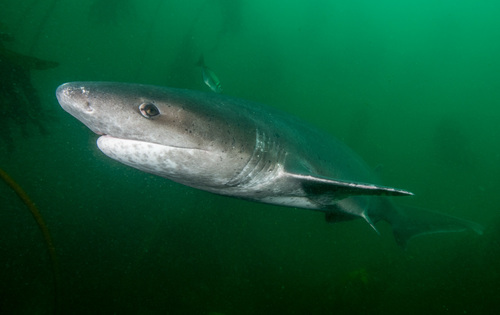
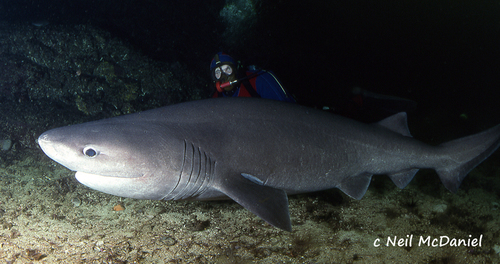
The bluntnose sixgill shark (Hexanchus griseus) has a large body and long tail. Its snout is blunt and wide, with small eyes. Its lower jaw holds 6 rows of saw-like teeth, while its upper jaw has smaller teeth. Skin color ranges from tan, through brown, to black, with a light-colored lateral line running along the sides and along the edges of the fins, plus darker spots on the sides. Stains or spots also form on the species' neural arches, and the number of these stains increases as the shark ages. The shark's pupils are black, and its eye tissue is fluorescent blue-green. Maximum confirmed length for the species is 5.5 m (18 ft); large specimens may reach 6 m (20 ft) in length and 1,000 kg (2,200 lb) in weight. One 1880s report claimed a 9 m (30 ft) individual caught off Portugal in 1846, but the original 1846 record for this specimen lists a length of only 0.68 m (2.2 ft). Adult males generally average 3.1 to 3.3 m (10 to 11 ft) long, while adult females average 3.5 to 4.2 m (11 to 14 ft) long. The average weight of an adult bluntnose sixgill shark is 500 kilograms (1,100 pounds).
This shark resembles many fossil shark species from the Triassic period, and more relatives of the genus Hexanchus appear in the fossil record than are alive today. It has a single dorsal fin located near the caudal fin, and broad pectoral fins with rounded edges. Its common name comes from its six gill slits; most modern common sharks only have five gill slits.
The bluntnose sixgill shark has a global distribution across tropical and temperate waters, found between latitudes 65°N and 48°S in the Atlantic, Indian, and Pacific oceans. It has been recorded off the coasts of North and South America from North Carolina to Argentina, and from Alaska to Chile. In the eastern Atlantic, it has been caught from Iceland to Namibia. In the Indo-Pacific it has been caught from Madagascar north to Japan and east to Hawaii, and in the Mediterranean it has been caught off Greece and Malta. Fossilized remains of this species from the Middle Miocene have also been discovered in the Duho Formation of South Korea.
The bluntnose sixgill shark typically swims near the ocean floor or in the water column over the continental shelf in poorly lit waters. It is usually found 180–1,100 m (590–3,610 ft) below the surface, inhabiting the outer continental shelf, but its overall depth range extends from 0–2,500 m (0–8,202 ft). Juveniles swim near the shoreline to search for food, sometimes in water as shallow as 12 m (39 ft), while adults typically stay at depths greater than 100 m (330 ft). The species can only be seen near the ocean's surface at night. On December 2, 2017, the ROV camera of Paul Allen's research vessel RV Petrel captured video of an adult bluntnose sixgill shark lurking around a World War II shipwreck in Ormoc Bay, Philippines at a depth of 259 m (850 ft); this was the first time the species was photographed in Philippine waters. In 2018, a sixgill shark was filmed near the Saint Peter and Saint Paul Archipelago, midway between Brazil and Africa, at a depth of around 120 metres (400 ft). In 2019, the remains of a pregnant bluntnose sixgill shark were found on a Vancouver Island beach, north of Victoria, British Columbia. On 18 October 2019, a large bluntnose sixgill shark over 3 metres (9.8 ft) long and weighing 900 kilograms (2,000 lb) was found dead on the beach of Ürkmez in the western province of Izmir, Turkey.
As a deep-dwelling species, the bluntnose sixgill shark performs diel vertical migration (DVM) to access more food. Research has found that the species takes more time to swim back down to its natural bathypelagic habitat than it does to swim upward at night to reach food-rich shallower zones, which suggests the shark has adaptations that aid buoyancy to make floating easier. One observed example of this behavior was recorded off the coast of Oahu, Hawaii, where four sixgill sharks were studied. Between midnight and 3 AM, the four sharks swam up to a minimum depth of 300 m (980 ft), while at noon they reached a maximum depth of between 600 and 700 m (2,000 and 2,300 ft). This forms a daily pattern: sharks move up to shallower depths to forage at night when it is darker and colder, then return to their deeper original habitat as light and water temperature increase with the coming of morning. This pattern lets them maintain a lower metabolic rate, allowing them to slowly use nutrients from their nighttime feeding and reduce the need to search for more food during the day.
Another study found that foraging is the motivating factor behind the bluntnose sixgill shark's DVM behavior. Researchers ruled out predator and competitor avoidance as potential reasons for these vertical movement patterns, after observing pairs of sharks with synchronized movements that indicated the sharks were responding to the same stimuli. The sharks showed distinct, consistent vertical migration patterns regardless of size, sex, and spatial scale, supporting the conclusion that foraging behavior drives the diel vertical patterns of sixgill sharks. The bluntnose sixgill shark also follows consistent seasonal movements: it moves north during winter and spring, and south during summer and fall. Research has linked these seasonal movement patterns to seasonal movements of the shark's prey, over other potential causes.
Scientists have successfully tagged sixgill sharks to study their behavior since 2005, but a sixgill was not tagged in its natural deep-sea habitat for the first time until 2019. Researchers from Florida State University, the Florida Museum of Natural History, the Cape Eleuthera Institute, and OceanX collaborated to tag a deep-sea shark using a submersible, and succeeded in the effort. The tag was set to float to the surface after three months, so scientists could collect the recorded data. This project demonstrated how technological advancements help scientists study marine life more easily, as researchers only needed to attach the tag once and collect it later to retrieve behavior data.
Although sluggish by nature, the bluntnose sixgill shark can reach high speeds to chase and catch prey using its powerful tail. Because of its broad range, it preys on a wide variety of organisms, including fish, rays, chimaeras, squid, crabs, shrimps, seals, and other smaller sharks. It is classified as a generalist species, so it is less likely to be affected by scarcity of any single food source. A 1986 study of 28 sixgill sharks found that the most common prey items were cartilaginous and bony fishes, followed by marine mammals and several invertebrates. A 1994 study of 137 samples found that the major prey groups were cephalopods, teleost fishes, chondrichthyans, and marine mammals. This difference in results may be due to the smaller sample size and less advanced technology of the 1986 study that produced a skewed result, or to increasing human activity altering the availability of different food sources for deep-dwelling sixgills; many factors may have contributed to the observed change in recorded stomach contents.
As hypothesized earlier, bluntnose sixgill sharks are positively buoyant. During vertical movements, the sharks exert more swimming effort for descent than ascent. This is shown by their greater number of tail beats during descent, and their ability to glide upwards for several minutes. Positive buoyancy helps the sharks hunt stealthily by approaching prey from below undetected, since upward gliding requires minimal movement. It is also advantageous for their diel vertical migrations: since the sharks spend their days in colder water, their metabolic rates decline, and positive buoyancy lets them glide upwards with minimal swimming effort during evening migrations.
Reproduction for the bluntnose sixgill shark is ovoviviparous: embryos receive nourishment from a yolk sac while developing inside the mother. Litters are large, typically producing 22–108 pups that measure 60–75 cm (24–30 in) at birth; the largest recorded pup at birth was 82 centimetres (32 in) long. Newborn pups have a lighter belly color than adults, a form of cryptic coloration or camouflage to disguise the pup's appearance. A high mortality rate for young pups is presumed, due to the large size of each litter. The gestation period is unknown, but it is probably more than two years, based on the gestation time of other hexanchiform sharks such as frilled sharks. Females reach sexual maturity at 4.5 m (15 ft) in length and between 18–35 years of age, while males reach sexual maturity much earlier at 3.15 m (10.3 ft) in length and between 11–14 years of age.
Many biologists hypothesize that the male bluntnose sixgill shark's teeth are specially adapted for courtship: the male nips at the female's gill slits using its longer-cusped teeth, an action thought to entice the female into mating. Evidence supporting this hypothesis is that female bluntnose sixgill sharks regularly have seasonal scars around their gill slits that appear to come from breeding with males. Males and females are thought to meet for mating seasonally between May and November.