About Hexagonia vesparia (Berk.) Ryvarden
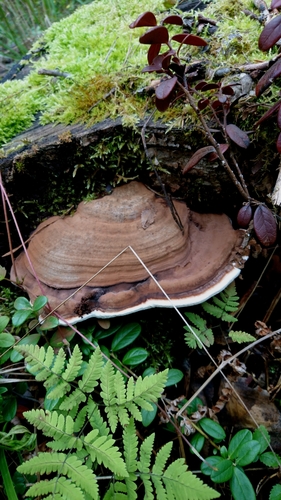
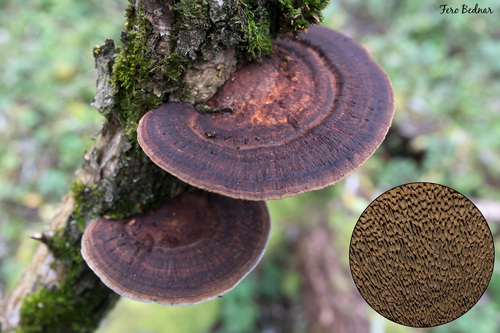
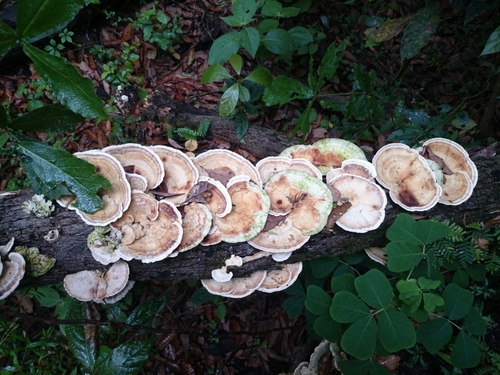
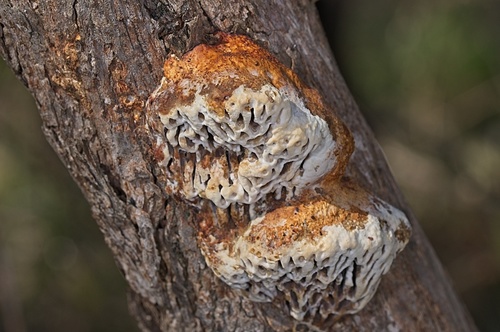
Commonly called the wasp nest polypore, Hexagonia vesparia is an irregular hoof-shaped bracket fungus, typically 25–80mm in diameter. Its hexagonal, radially elongated pores give it an appearance matching a wasp nest. The fungus has a hard, woody flesh texture, and its fruiting body extends around 5 centimetres out from its growing substrate. The pore colour changes from off-white to dark brown as the fungus ages. Its spores are smooth and cylindrical, measuring 14–17 × 5–7 micrometres. The upper surface of the bracket, where it attaches to the substrate, may be hairy, and features bumps and channel-like grooves. Its greatest currently known distribution is across Victoria, New South Wales, and Perth, with sparse records in the Northern Territory, South Australia, and Queensland. Fungal surveys in Australia have historically been limited, with most research focus placed on fauna and flora; as fungi are increasingly included in modern surveys, recorded distribution ranges for Hexagonia vesparia and other fungal species are expected to expand. The wasp nest polypore grows on branches and trunks of living trees, as well as on dead logs. It is most commonly found in rainforest and wet sclerophyll forest, but has also been recorded in the more semi-arid Eucalypt Mallee Woodland. Fungi are sorted into groups based on their shape, form, texture, and function, and these groups are called morphogroups. The wasp nest polypore is classified as a pored saprophytic fungus; saprophytic fungi make up the largest group of macrofungi. Saprophytic fungi act as ecosystem recyclers, breaking down organic material by releasing enzymes. These enzymes break down lignin, cellulose, or chitin from the organic material and convert it into a soluble compound that the fungus can use, which also acts as a nutrient source for other plants. This group of fungi plays a critical role in clearing dead organic material from forests and recycling key nutrients including carbon and nitrogen. The most visible part of this bracket fungus is its reproductive fruiting body, called a basidiocarp — the spore-bearing structure that extends outward from the substrate. Spore-producing basidia are located on the underside of the bracket. As a member of Basidiomycota, Hexagonia vesparia reproduces sexually. For germination on a new substrate to occur, haploid spores from two different mating strains must fuse in a process called karyogamy, which produces a diploid zygote that develops into a dikaryotic organism. Mature haploid basidiospores are dispersed through the air to new host trees or dead logs, or are carried by water droplets. Thin, elongated structures called hyphae grow into a network within the wood of the host substrate. This collection of hyphae forms the mycelium, which spreads through the wood to colonise the new substrate.