About Hexagenia limbata (Serville, 1829)
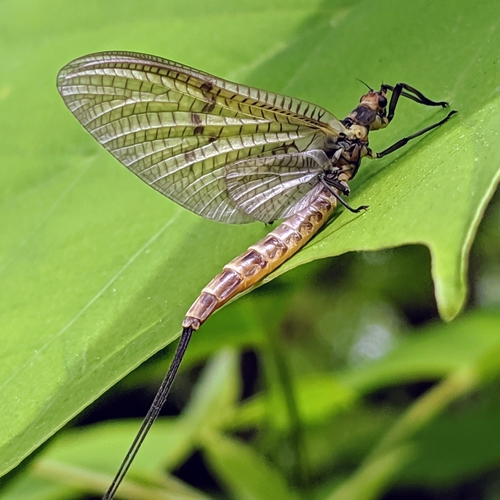
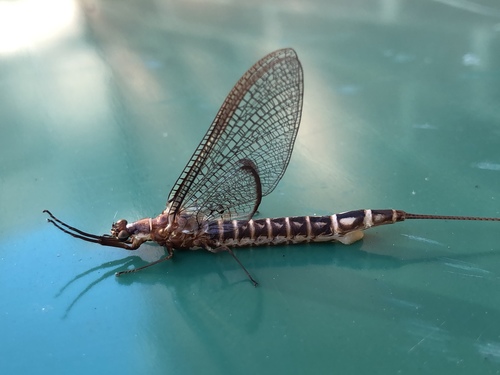
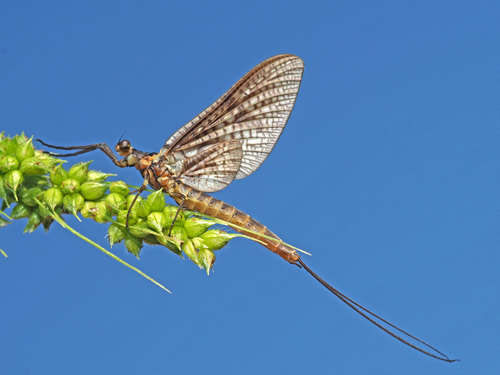
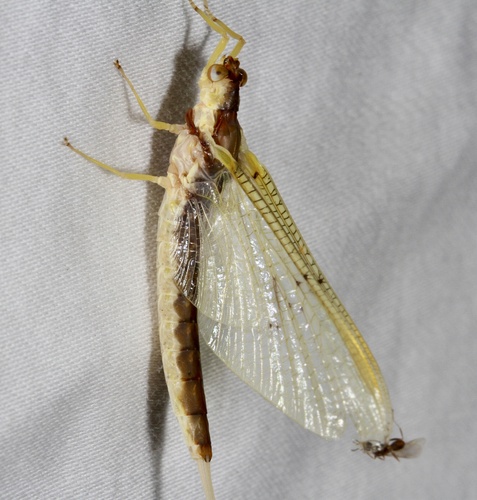
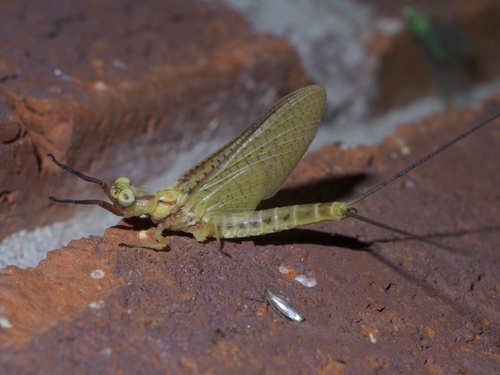
Hexagenia limbata (Serville, 1829) is a species of mayfly. Mature adult Hexagenia limbata can reach up to 27 mm (1.1 in) in length. Females are generally slightly larger than males, but have smaller eyes. Their forewings are long and membranous, while the hindwings are much smaller and have dark margins. Two long cerci, or tails, are located at the tip of the abdomen. When at rest, the wings are folded vertically above the back. Color and body markings are somewhat variable, but individuals are usually some shade of yellow, pale brown, or white. Hexagenia limbata is the most widely distributed mayfly in North America. It is found across most of Canada, and in every US state except Alaska and Arizona. It is most common in the Great Lakes region. Its habitat includes lakes and slow-moving rivers with muddy bottoms, where nymphs can burrow. Adult mayflies can be found swarming near the water, or resting in vegetation. Females lay their eggs in the water, and the eggs sink to the bottom. Some eggs hatch fairly soon, but many overwinter as eggs and hatch in spring. A newly hatched nymph is about 1 mm (0.04 in) long, with a long, roughly cylindrical body. Nymphs go through up to thirty molts during development. They have digging tusks on their mandibles, three pairs of legs, developing wingpads in later growth stages, and three elongated tails. Each nymph lives in a U-shaped burrow it excavates in mud, and has seven pairs of feathery gills on its abdomen that it uses to waft water through the burrow to increase aeration. Development may take two years in cold northern lakes, but can be as short as seventeen weeks in southern US canals. When a fully developed nymph rises to the surface to become an adult, it first enters the subimago stage. The subimago resembles the adult, but has cloudy rather than clear wings, and lacks functional genitalia. After one to three days, the subimago flies to a resting spot where it molts one more time to become a sexually mature adult, the imago. Subimago and adult mayflies do not have functioning mouthparts and do not feed. Nymphs are mainly detritivores, feeding on organic particles that their constantly beating gills draw into their burrows. Dragonfly nymphs prey on Hexagenia limbata nymphs, attacking them inside their burrows. Nymphs do not normally leave their burrows until they are fully developed. Once developed, they swim to the surface, split their skins, emerge as subimagos and fly away. At emergence, they are highly vulnerable to predators, and are eaten by various fish, dragonflies, and birds. The synchronized mass emergence of this species is known to fishermen as the "hatch"; this synchronization is thought to improve the chance of finding a mate. Hexagenia limbata mayflies are attracted to artificial human lighting at night, and can form large swarms at locations such as gas stations. Car lights on bridges can attract swarms, which may leave road surfaces slippery. Large hatches can even show up on weather radar. While hatching is not strictly simultaneous across a region, it still follows a clear peak emergence period.