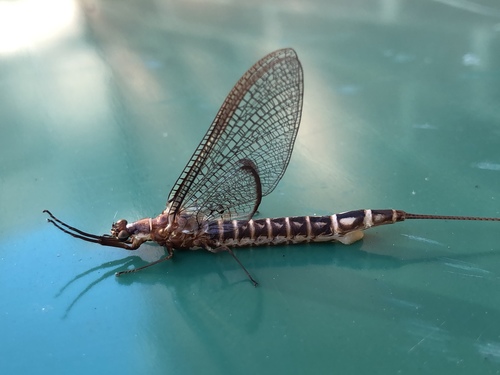
About Hexagenia bilineata (Say, 1824)
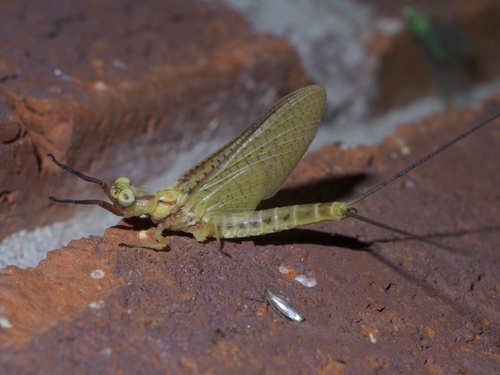
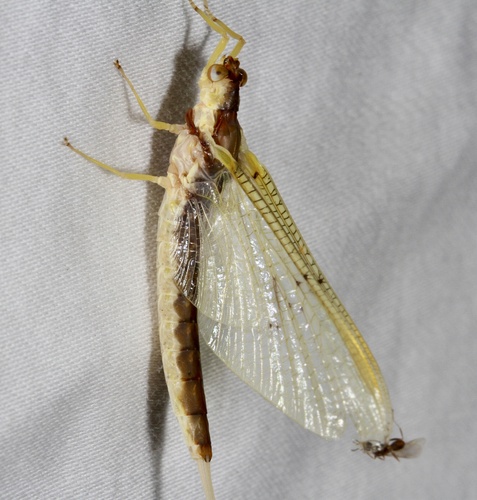
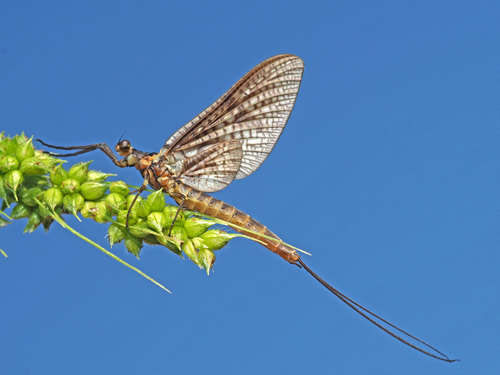
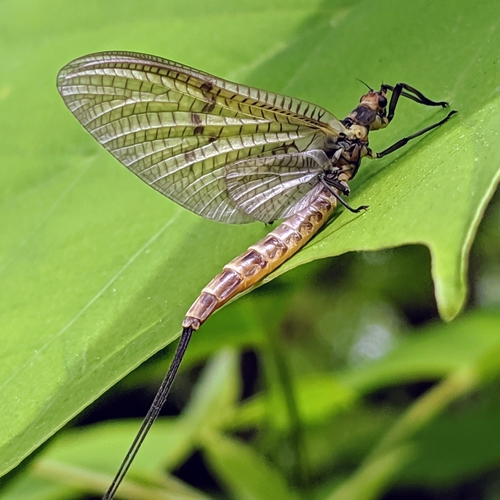
When adult Hexagenia bilineata are ready to emerge, the mayfly nymphs (larvae) swim to the water surface at night. Their skin splits, and winged subimagos struggle free, usually in less than a minute, before flying to nearby trees to rest. Subimagos are dull gray, with short, coarse legs, bristly cerci, and cloudy grayish wings. After eight to eighteen hours, these subimagos moult into mature adults (imagos). Mature imagos have a far more delicate appearance than subimagos: their wings are transparent, legs are longer and more slender, cerci have no bristles, eyes are larger, and the body is patterned brown and cream. Females are much larger than males. Hexagenia bilineata occurs in the Upper Mississippi Valley. Adults emerge in summer and live near still and slow-moving water. Nymphs burrow in mud and silt in shallow lakes, and slow-moving streams and rivers. This mayfly is generally more abundant than the closely related Hexagenia limbata, though H. limbata becomes more plentiful from Keokuk, Iowa northwards. When a lock near Keokuk was drained in July 1958, 344 H. bilineata nymphs were found in 10.5 square feet (1 m²) of sediment. Around dusk, mature male imagos gather in swarms. They often aggregate in the lee of structures like buildings or trees, and will circle the whole structure if there is no wind. Each male holds a fixed position facing into the wind, around 30 cm (one foot) away from the next male, and stabilizes its position with its cerci. Unlike H. limbata males, these males do not bob up and down. Any female that flies into the swarm is pursued by males until copulation occurs mid-air. The male then returns to the swarm, and all members of the swarm die before morning. The female lays two egg packets, each holding several thousand eggs, into the water; the packets sink to the bottom and stick to the mud. She dies soon after laying, and any undeposited egg packets may be pushed out of her corpse after her death. Each egg hatches a few weeks after being laid, and the newly hatched nymph tunnels into the mud to create a U-shaped burrow. It generates a water current through the burrow to supply itself with oxygen, and filters organic detritus from this current to feed on. It stays in this burrow until it is ready to emerge the following year. This mayfly may have a shorter life cycle than other members of its genus. When reared in the laboratory at warm temperatures, it developed from egg to adulthood in thirteen weeks. In the Keokuk area, it is thought to produce one new generation per year. In Kentucky Lake, it has mixed voltinism, with some adults emerging after 14 months and others after 22 months.