About Hewittia malabarica (L.) Suresh
Hewittia malabarica (L.) Suresh is a herbaceous perennial plant with a growth form similar to some species in the Convolvulus genus. It can be twining, climbing, or prostrate, with slender, velvet-hairy (pubescent) stems that reach 1–3 m (3 ft 3 in – 9 ft 10 in) in length. Stems may twine or climb into surrounding vegetation, scramble over the ground, and occasionally form new roots at their nodes.
Its leaves grow in an alternate arrangement, with leaf stalks (petioles) 1–9 cm (0–4 in) long. Leaves range from oblong to obovate (teardrop) in shape, measuring 2–14 cm (1–6 in) long and 3–10 cm (1–4 in) wide. They have entire (smooth) or dentate (toothed) margins, an acuminate (long-pointed) apex, and a cordate (heart-shaped) or hastate (halberd-shaped) base. Leaf texture ranges from pilose (bearing soft, separate hairs) to velvety across the surface.
Its flowering time varies by location: it blooms in May in Pondoland, Cape Province, South Africa, while it flowers and fruits nearly year-round in China. 1 to 3 axillary flowers (arising from leaf axils) grow per cyme near leaf joints. Each flower is bracteate (has bracts), held on a 1.5–10 cm (1–4 in) long peduncle (flower stalk). Bracts are oblong-lanceolate, 0.7–1.5 cm (0–1 in) long, pubescent (covered in short, soft hairs), and acuminate (tapering to a point). Inflorescences hold bisexual flowers that bear both male and female reproductive organs, each on a pedicel up to 3 cm long.
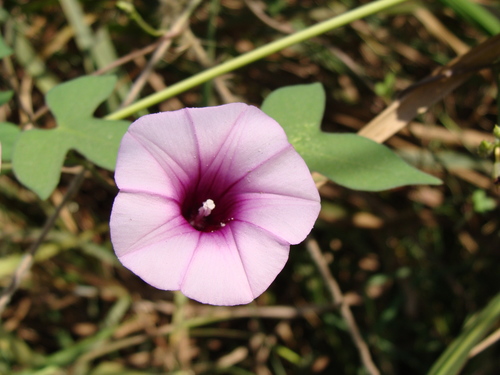
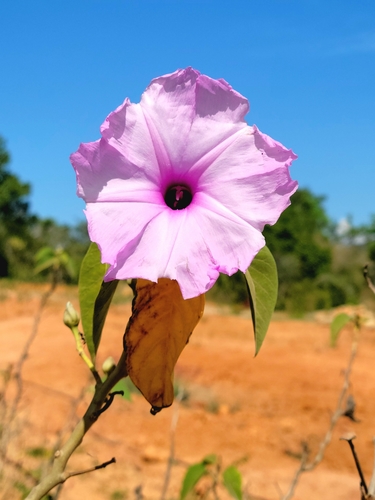
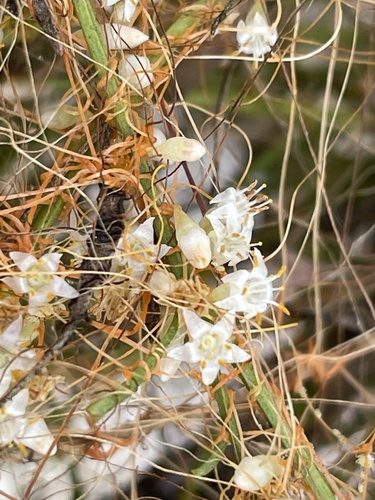
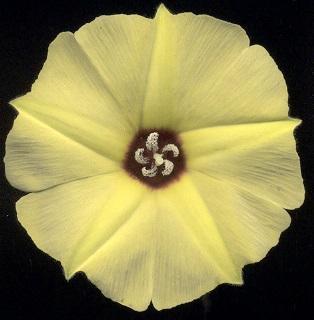
This species has 5 lanceolate to ovate sepals that reach up to 17 mm in length; the outer three are much larger than the inner two, and this arrangement of overlapping sepals distinguishes it from similar colored morning glory flowers. The corolla (group of petals) is campanulate (bell-shaped) to funnel-shaped, 2–3.5 cm (1–1 in) long, and pale yellow, cream, or white with a purple center. The outer surface of the petals has five bands of soft, weak, thin, separated hairs (it is pilose in these bands). Stamens are approximately 9 mm long, located inside and enclosed by the corolla tube. It has a superior ovary positioned above other flower structures, which is 1 or 2 celled, hairy, or villous (covered with long, soft, straight hairs). The style is thread-like (filiform), the two stigmas are ovate-oblong shaped, and the anthers are ovoid-deltoid shaped.
After flowering, it produces a pilose seed capsule (fruit) that is depressed globose (almost spherical) to quadrangular (almost square), with 4 valves and a diameter of 8–10 mm (0–0 in). The capsule holds 2 to 4 black, sub-globose seeds 3–6 mm (0–0 in) in diameter, and retains a persistent style.
This species has a widespread native range across the tropical and subtropical Old World, including tropical Africa, Asia, and Polynesia. Specific countries and regions where it grows include Angola, Bangladesh, Benin, Borneo, Burundi, Cambodia, Cameroon, Central African Republic, Chad, south-central and southeastern China (Guangdong, Guangxi, Hainan, Yunnan), Eswatini, Ethiopia, Gabon, Gambia, Ghana, Guinea, Ivory Coast, Jawa, Kenya, Laos, Lesser Sunda Islands, Liberia, Madagascar, Malawi, Malaya, Mali, Maluku, Mozambique, Myanmar, New Guinea, Nigeria, Philippines, Rwanda, Senegal, Sierra Leone, Somalia, South Africa (Cape Provinces, Northern Provinces, KwaZulu-Natal), Sri Lanka, Sudan, Sumatra, Taiwan, Tanzania, Thailand, Togo, Uganda, Vietnam, Zambia, Zaire, and Zimbabwe. It has been introduced and naturalized in Jamaica.
Its habitats include grassland, mixed open woodlands and forests, forest edges, bushveld, forest clearings, roadsides, dry watercourses, and stream banks. In Africa, it grows at altitudes from 0 to 1,800 metres (0 to 5,906 ft) above sea level, while in China it only grows up to around 600 m. It is classified as a ruderal or agrestal weed (a wild plant growing in cultivated fields) in cultivated areas and on waste ground.
It can grow in a wide range of soil types, and grows best in deep sandy loams with permanent moisture. In Tanzania, it naturally occurs in areas with mean annual rainfall between 1,100 and 2,100 mm, and tolerates locations with either a pronounced dry season or almost no dry season. It can be propagated from seed.
It has a variety of uses: it is edible, has medicinal applications, is used to make rope, and is grown as an ornamental garden plant. In folk medicine, its leaves are rubbed onto sores. In China, its leaves are used in oral decoctions and baths, and a decoction of the root is drunk to expel Oxyuris (threadworms) from the body. Its leaves are collected from the wild and cooked as a vegetable, often harvested when other vegetables are scarce. After chopping and boiling, the water is drained, and the leaves are mixed with pounded groundnuts or coconut milk, then eaten with ugali or rice. Alternatively, the leaves are cooked with other vegetables like Amaranthus or bidens, with coconut milk or groundnut paste added, and the mixture is served with a staple such as rice. In Uganda, the leaves are a popular ingredient in the traditional Langi dish called onyebe. It is also occasionally grown as an ornamental plant, or as a ground cover in plantations. In Madagascar, it is used as a cover plant in ylang-ylang (Cananga odorata (Lam.) Hook f. & Thomson) plantations, and is grazed by cattle. It is used as cattle fodder alongside a wide range of other plants in Benin. Fiber from its inner bark is used to make ropes.