About Heterotis rotundifolia (Sm.) Jacq.-Fél.
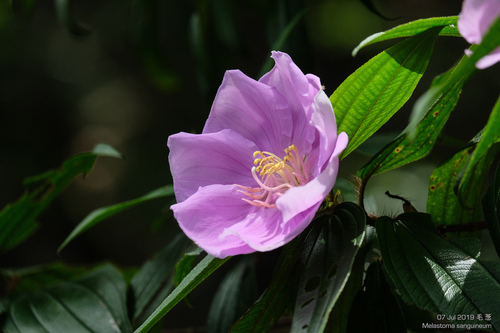
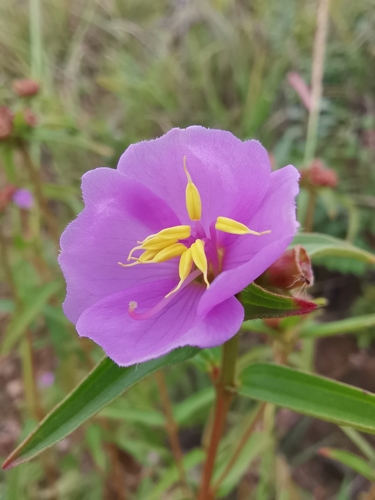
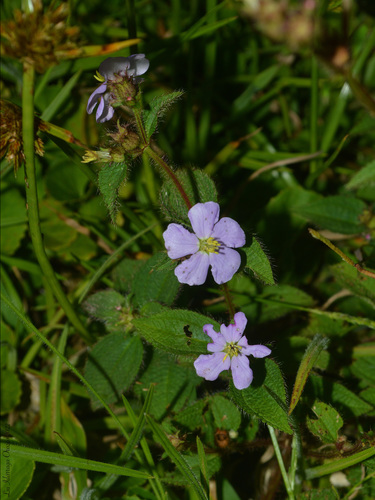
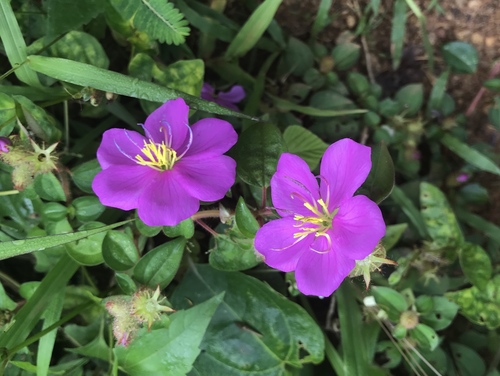
Heterotis rotundifolia can grow in multiple growth forms: fully erect, completely prostrate (lying flat), or decumbent, where branches lie flat on the ground with upturned tips. When stems trail, they root at the nodes, the points where leaves connect to the stem. The lower sections of the stems are woody, while the upper parts of the stems are hirsute (covered with coarse hairs). The spreading branches range in color from pink to dark reddish. The leaves are oval-shaped, three-ribbed, 1–3 cm (0.39–1.18 in) long, and 6–15 mm (0.24–0.59 in) wide, with short, pressed flat hairs on both sides. Leaf stalks are up to 1.5 cm (0.59 in) long, covered with soft distinct hairs, and pink. The flowers of Heterotis rotundifolia are solitary, and their stalks are covered in tiny pressed flat hairs, just like the leaf stalks. Flower petals measure 1.5–2 cm (0.59–0.79 in) long and range in color from pink to pale purple. Heterotis rotundifolia is native to central and western Africa, where it occurs naturally from Sierra Leone to Zaire. It has been introduced to other tropical regions as an ornamental plant and ground cover, including Hawaii, Malaysia, and the West Indies, and has become naturalized in some tropical parts of Australia. This shrub grows at elevations between sea level and around 1,900 m (6,200 ft). The leaves of Heterotis rotundifolia are used as a spice in sauces and as a potherb. In Liberia, the plant is used as a diuretic.