About Heterotis niloticus (Cuvier, 1829)
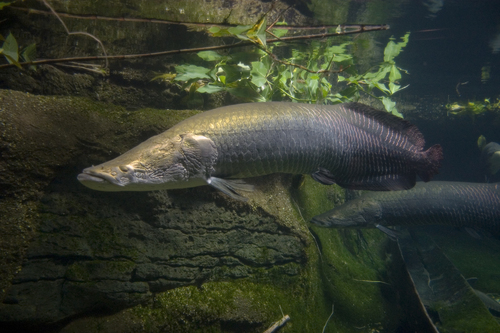
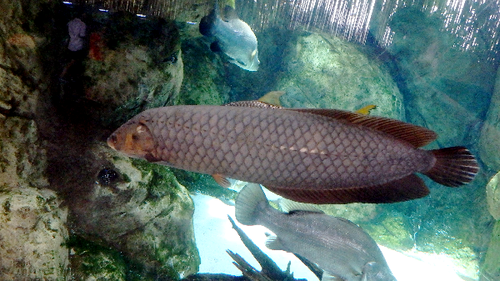
African arowana, whose scientific name is Heterotis niloticus (Cuvier, 1829), is a long-bodied fish with large scales, long dorsal and anal fins placed far back on the body, and a rounded caudal fin. Its body height is 3.5 to 5.0 times its standard body length. Reported maximum measurements for this species are up to 1 m (3.3 ft) in length and up to 10.2 kg (22 lb) in weight. The fish can be gray, brown, or bronze in color. Adult individuals have uniform coloration, while juveniles often have dark longitudinal bands. African arowanas have air-breathing organs on their branchiae, which allow them to survive in water with low oxygen levels. They also have a suprabranchial organ that lets them concentrate small planktonic food particles, and this organ also serves a sensory function. This species is native and widespread across much of Africa. Its native range covers all watersheds in the Sahelo-Sudanese region, Senegal, Gambia, and parts of eastern Africa. This native range includes the basins of the Corubal, Volta, Ouémé, Niger, Bénoué, and Nile Rivers, along with the basins of Lake Chad and Lake Turkana. It has been successfully introduced to Côte d'Ivoire, the Cross River in Nigeria, the Sanaga and Nyong Rivers in Cameroon, the Ogooué River in Gabon, the lower and middle Congo River basin including the Ubangui and Kasaï Rivers, and Madagascar. In some cases, these introductions have been recorded to cause negative impacts on local ecology. Locally, African arowana is used as a food fish, and it was collected for the aquarium trade in the past. Unlike many of its close relatives, it is not aggressive. It is raised through aquaculture within its native range, and aquaculture of this species is very successful because it tolerates crowding well and is easy to feed.