About Heterotheca depressa (Rydb.) Dorn
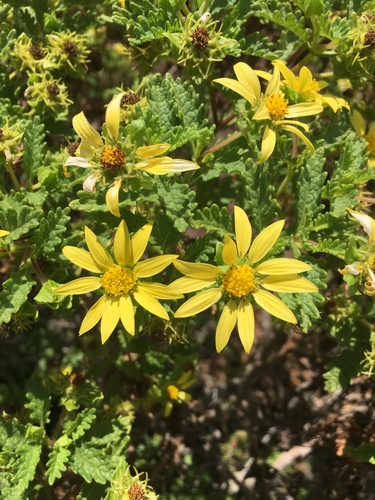
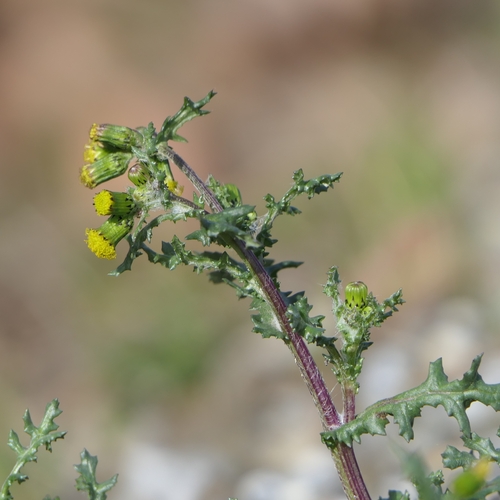
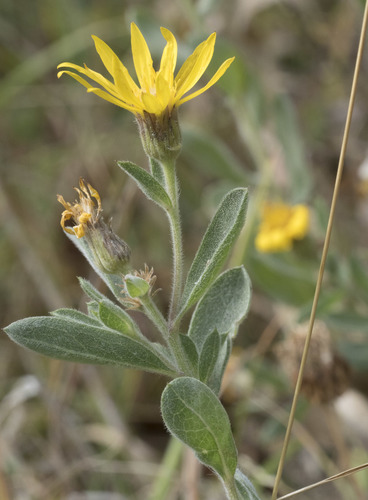
Heterotheca depressa, commonly called hairy golden aster, grows 5 to 70 centimeters (2 to 28 inches) tall, with a more typical height range of 16 to 40 centimeters (6 to 16 inches). Its leaves can reach up to 60 centimeters (24 inches) in length, and are most often 22 to 40 centimeters (9 to 16 inches) long. It blooms from May to October, producing flower heads roughly 2.5 centimeters (1 inch) wide that contain both yellow ray florets and yellow disk florets. Its seeds have white bristles at their tip. This species can be hard to identify, as it has many close relatives and a large number of recognized varieties. The varieties recognized are: Heterotheca villosa var. ballardii, found in the northern Great Plains of the United States and Canada; Heterotheca villosa var. depressa, native to Wyoming; Heterotheca villosa var. foliosa, found in the Rockies, Black Hills, northern Cascades, and other nearby areas; Heterotheca villosa var. minor, found in the Rockies, Cascades, Sierra Nevada, and other nearby areas; Heterotheca villosa var. nana, found in the Rockies and other mountains ranging from South Dakota to Arizona; Heterotheca villosa var. pedunculata, found in Arizona, New Mexico, Colorado, and Utah; Heterotheca villosa var. scabra, found in Mexico and the southwestern United States; Heterotheca villosa var. sierrablancensis, native to New Mexico; and Heterotheca villosa var. villosa, found in the northern Great Plains, Columbia Plateau, and other nearby areas. This species is widespread across central and western North America, ranging from Ontario west to British Columbia, and south to Illinois, Kansas, Nuevo León, Guanajuato, and northern Baja California. It grows successfully in dry areas, and also occurs on plains, rocky slopes, and cliffs, at low elevations, and within coniferous forests. Wildflower gardener Claude A. Barr considered this plant useful for gardens, due to its abundant masses of bright yellow flowers.