About Heteropteryx dilatata (Parkinson, 1798)
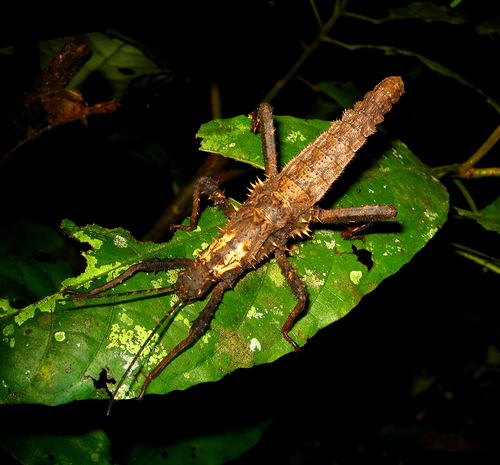
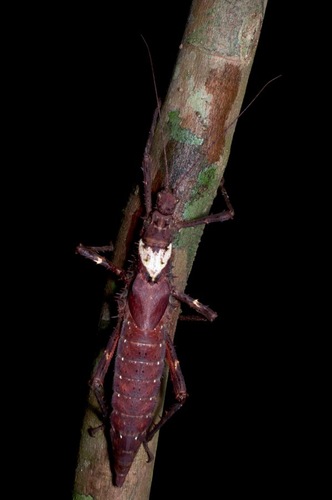
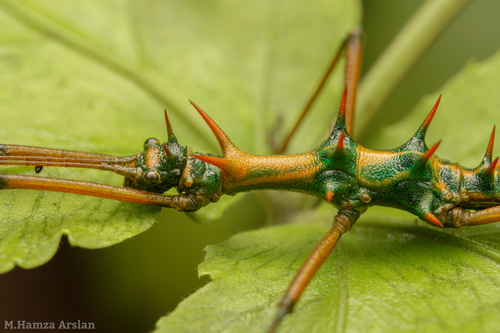
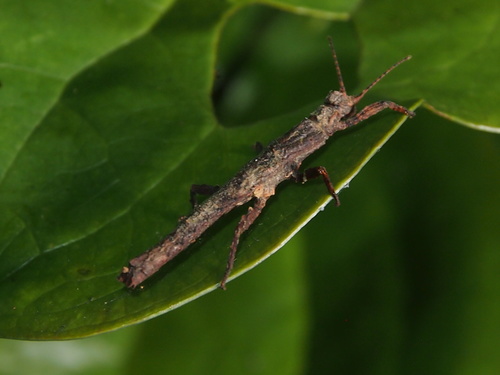
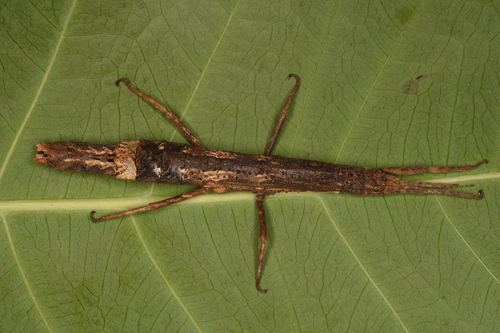
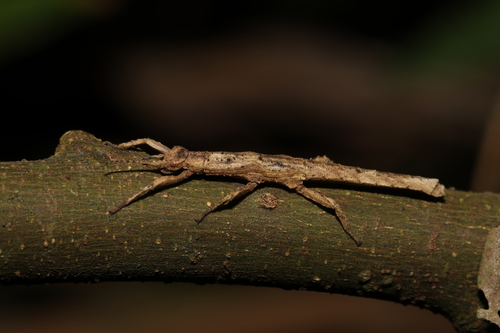
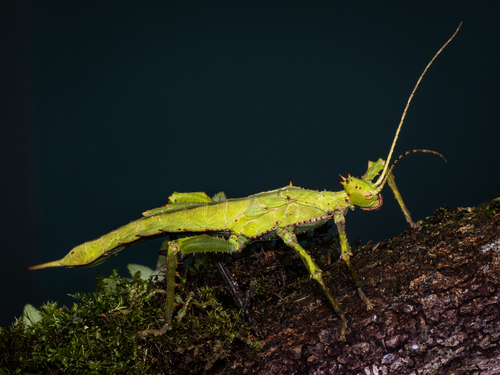
Female Heteropteryx dilatata are much larger and wider than males, reaching 14 cm (5.5 in) to 17 cm (6.7 in) in length and 30 to 65 g in weight, making this species one of the heaviest phasmids and one of the heaviest extant insects. While most females are typically lime green, yellow and more rarely red-brown female individuals also exist. Both pairs of wings are shortened in females. When at rest, the green forewings, modified into tegmina, cover the slightly shorter, distinctly pink membranous hind wings (modified into alae), but females cannot fly. The head, body, and legs of females are covered in thorns. Their flattened body has a number of spines, particularly along the body edges including the abdomen and legs, and most densely along the hind legs. At the tip of the abdomen, there is a secondary ovipositor that is used to lay eggs into the ground. This secondary structure surrounds the actual ovipositor; it forms ventrally from the eighth sternite, called the subgenital plate or operculum, and dorsally from the eleventh tergum, called the supraanal plate or epiproct. Males are much smaller, slender, and only reach 9 cm (3.5 in) to 13 cm (5.1 in) in length. Like females, males have spines covering their entire body and legs, and they are usually a mottled brown color. In males, the hind wings cover the entire abdomen. The narrow forewings, only slightly shorter than the hind wings and also modified as tegmina, have a pale leading edge. This creates a distinct lateral stripe over the mesonotum and half the abdomen when the wings are closed. Males have fully developed reddish hind wings marked with a brown net-like pattern. Heteropteryx dilatata is native to the Malay Archipelago, where it has been recorded on the Malay Peninsula, in Thailand, Singapore, on Sumatra, and in Sarawak on Borneo. It is unconfirmed whether recorded populations of this species on Madagascar are native. Both sexes can perform defensive stridulation when threatened. They repeatedly jerk their colored hind wings open to deter predators. Additionally, like closely related Haaniella species, they threaten attackers by raising their abdomen and extending their spread hind legs toward the threat. If contact occurs, the legs snap closed like a scissor. When touched, the tibiae of the hind legs strike quickly against the femora; the spines on these structures, especially the spines on the tibiae, create an effective defense. It is a common misconception that Heteropteryx dilatata lays the largest insect egg, with some sources claiming its eggs reach 1.3 cm (0.51 in) in length. The heaviest phasmid eggs, weighing 250 to 300 mg and measuring up to 1.2 cm (0.47 in) long and around 0.8 cm (0.31 in) wide, belong to the closely related Haaniella echinata. Asceles malaccae females, which reach just under 10 cm (3.9 in) long, lay eggs that can be up to 1.5 cm (0.59 in) long, but only around 0.2 cm (0.079 in) in diameter. The eggs of Heteropteryx dilatata are 0.7 cm (0.28 in) to 0.8 cm (0.31 in) long, 0.5 cm (0.20 in) wide, and weigh around 70 mg. Females lay these eggs individually into the ground using their ovipositor. Nymphs hatch after approximately 7 to 14 months. Young nymphs can change their color to be lighter during the day and darker at night, and form communal sleeping groups up until the fourth larval stage, where the insects cling together in clumps or chains on their host food plants. Newly hatched nymphs are generally beige in color. Males darken slightly with each molt, while females change from beige to green after their third molt. The final molt to the adult (imago) stage occurs about one year after hatching; this is the fifth molt for males and the sixth molt for females. Adult Heteropteryx dilatata live for approximately 6 to 24 months. As with many other phasmid species, gynandromorphs (half-sided hermaphrodites) occasionally occur in Heteropteryx dilatata.