About Heteropogon melanocarpus (Elliott) Benth.
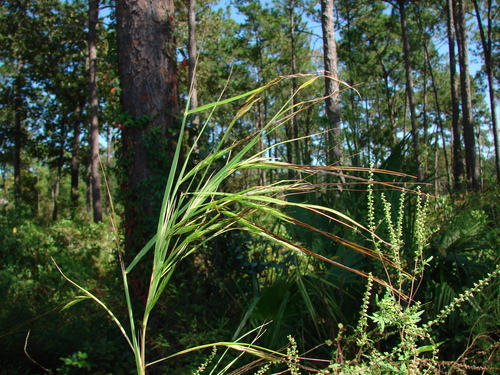
Heteropogon melanocarpus (Elliott) Benth. is a coarse annual grass. Its culms are glabrous, and grow between 0.8 and 2 meters tall. Its leaves are primarily cauline, with blades reaching up to 40 cm long and around 1 cm wide. The upper surface of the leaf near the collar region is covered in long hairs, the leaf margins are slightly rough, and the leaf sheaths are mostly glabrous and sometimes glandular; the upper sheaths are inflated and often have a thin, dry scarious texture along their margins. The ligules are membranous, lacerate, and measure 2–4 mm long. The inflorescence is made up of compact, stalked pedunculate racemes that emerge from the inflated upper sheaths. The racemes are 2–4 cm long when awns are excluded. Each raceme holds one fertile and one staminate sessile spikelet, paired with a staminate pedicellate spikelet. The first glume of the pedicellate spikelet is asymmetric, prominently nerved, acuminate, 12–17 mm long, with one margin that is winged and dotted with glands; the second glume is membranous and similar in shape to the first. Both fertile and sterile lemmas are hyaline, reduced in size, and do not have a palea. The awn of the fertile lemma is twisted, bent at an angle, covered in brown hairs, and can reach up to 10 cm long. The callus is appressed, covered in brown hairs, and measures 2–3 mm long. The grains are yellowish, linear, cylindrical (terete), and approximately 4 mm long. In the United States, Heteropogon melanocarpus occurs from North Carolina south to Florida, and west to Arizona. It is thought to be naturalized from the Old World, and is widespread across the Old World and New World tropics and subtropics. It grows in sandy roadside areas and disturbed habitats, and is known to persist through repeated disturbance from prescribed fire.