About Heteronotia binoei (Gray, 1845)
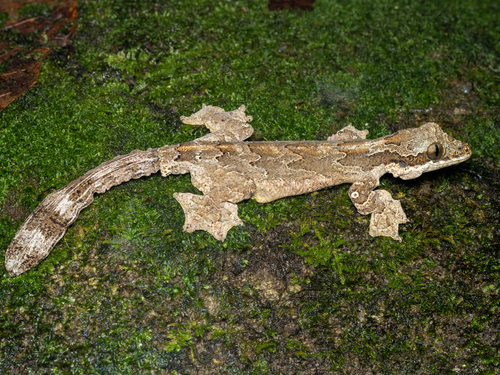
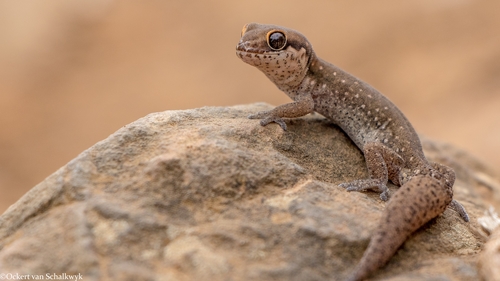
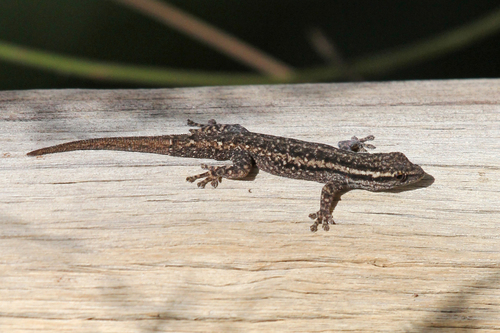
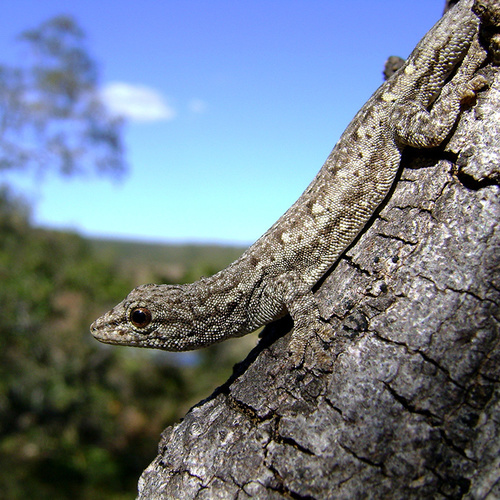
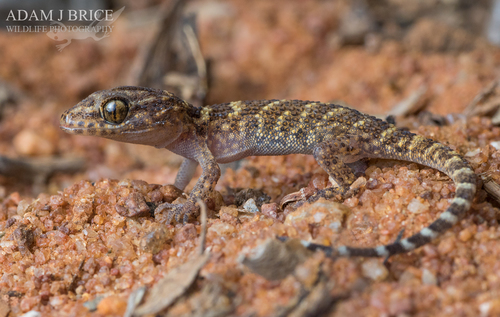
Bynoe's gecko, also known by the alternative common name prickly gecko, is a slender, long-tailed gecko species that can reach a total length of 11–12 cm (4.3–4.7 in) including the tail. Its body is covered in small scales that look rough but are soft to the touch. It has slim toes tipped with strong claws, and unlike many other gecko species, it does not have expandable toe pads. It has a large head and large eyes; it lacks eyelids, and its eyes are instead covered by transparent scales. It uses its tongue to wipe dirt and dust from its eye lenses to keep them clean. Small spine-like ridges run along the full length of its back, which gives it the alternative common name prickly gecko. Its base coloration can include yellow, cream, beige, black, or white, and most individuals have at least two of these colors. The body may be patterned with stripes, speckles, spots, or blotches. It usually has a faint dark temporal streak, plus a second dark streak running along the canthus rostralis. Its lips are whitish, and typically have light freckling of darkish brown. Like many gecko species, it has well-developed vocal chords that allow it to produce a wide range of calls. This species is endemic to Australia. It occurs in all mainland Australian states except the Australian Capital Territory, and is not found in the humid regions of southeastern and southwestern Australia. It also lives on many islands off Australia's west coast, and has large established populations on Barrow Island. Bynoe's gecko inhabits a wide range of habitats across Australia. It is most common in open, dry environments including woodlands, grasslands, and disturbed habitats. It can also be found in tropical rainforests, central Australian deserts, and coastal sand dunes. As a terrestrial species, it shelters under all types of ground cover, including leaves, logs, stumps, stones, termite mounds, loose bark at the base of trees, and animal burrows. It has also been recorded sheltering in man-made habitats. This species is often the most abundant reptile in many arid areas of Australia. In Australia, Bynoe's gecko reaches ideal breeding condition between July and September. Individuals reach sexual maturity between 1 and 3 years of age. Females lay clutches of 2 eggs from September through January. When first laid, the eggs have soft shells, which harden and become brittle after exposure to air. Clutches are typically deposited under rocks, inside animal burrows, or inside logs. Each female produces only one clutch per year. On Barrow Island, female Bynoe's geckos reproduce via parthenogenesis, a form of asexual reproduction where embryos grow and develop without fertilization by a male. Both parthenogenetic and sexual populations of Heteronotia binoei occur together in parts of the Australian arid zone. Laboratory measurements show that parthenogenetic Bynoe's geckos have approximately 30% lower fecundity than their sexual parent populations.