About Heterodontus portusjacksoni (Meyer, 1793)
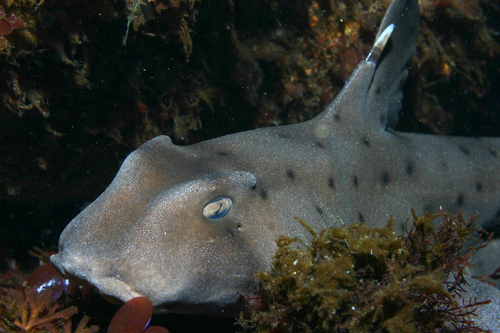
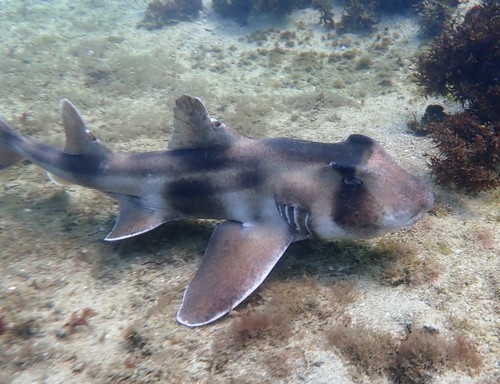
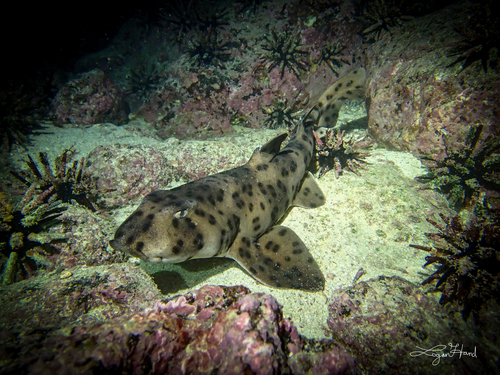
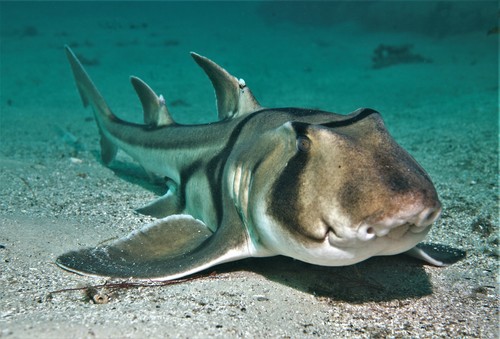
The Port Jackson shark, scientifically named Heterodontus portusjacksoni, is a nocturnal, egg-laying (oviparous) bullhead shark belonging to the family Heterodontidae. It is found in coastal waters of southern Australia, including the waters off Port Jackson. This species has a large, blunt head with prominent forehead ridges, dark brown harness-like markings over a lighter grey-brown body, and can reach a maximum length of 1.65 metres (5.5 ft). It is the largest species in the genus Heterodontus. Port Jackson sharks are migratory: they travel south in the summer, and return north to breed in the winter. Their diet consists of hard-shelled mollusks, crustaceans, sea urchins, and fish. This species is easy to identify thanks to its characteristic harness-like marking pattern: the markings cross the eyes, run along the back to the first dorsal fin, then cross the side of the body. It also has a spine positioned in front of each of its two dorsal fins. The Port Jackson shark is endemic to temperate waters around southern Australia, with a distribution range stretching from southern Queensland, south to Tasmania, and west to the central coast of Western Australia. There are unconfirmed reports of catches as far north as York Sound, Western Australia. One specimen was collected in a set net at Mākara, Wellington, New Zealand in 1954. Two more specimens reported to be from New Zealand were given to the British Museum; while these two specimens have been found, no collection location information exists to confirm their New Zealand origin, even though the species has been recorded off the coast of New Zealand on one occasion. Genetic studies indicate there are two separate Australian populations of this species: one ranges from Northeastern Victoria to Western Australia, and the second ranges from Southern Queensland to New South Wales. The species is thought to have originated off the coast of South Africa. Port Jackson sharks usually live at depths of less than 100 metres (330 ft), but have been recorded as deep as 275 metres (902 ft). Their territory is typically on or near the sea bottom, which is also where they feed. Rocky environments are their most common habitat, though they sometimes also use sandy, muddy areas, and seagrass beds. During the day, when they are generally inactive, they can be found in flat areas that offer shelter from currents—including caves—or near other sheltered spots such as rocky outcrops. Male Port Jackson sharks reach sexual maturity between 8 and 10 years of age, while females reach maturity between 11 and 14 years of age. The species is oviparous, meaning females lay eggs rather than giving birth to live young. It has an annual breeding cycle that runs from late August to mid-November. During the breeding season, a female lays a pair of eggs every 8 to 17 days, and can lay up to eight pairs total. The eggs take 10 to 11 months to mature before hatchlings (called neonates) can break out of the egg capsule. Recent studies have found that the eggs have an 89.1% mortality rate, mostly caused by predation.