About Heterodontus galeatus (Günther, 1870)
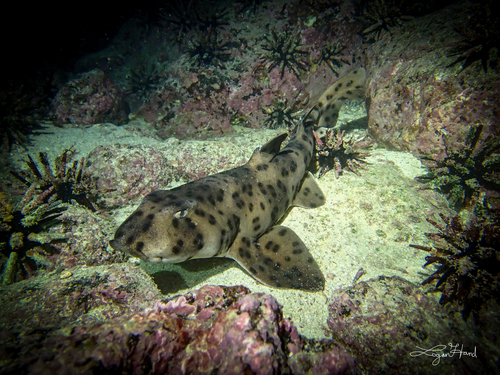
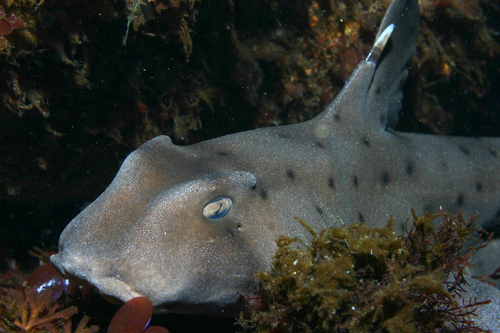
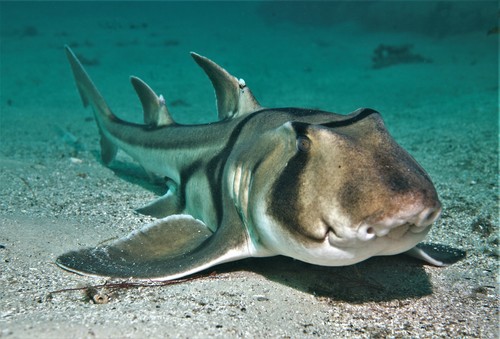
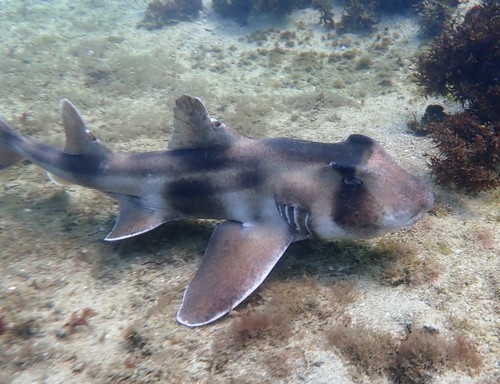
Heterodontus galeatus, commonly known as the crested bullhead shark, has a short, wide head with a blunt, pig-like snout. Its eyes are set high on the head and do not have nictitating membranes; the supraorbital ridges above its eyes are larger than those of any other member of its family. Its nostrils are divided into incurrent and excurrent openings by a long flap of skin that extends to the mouth. One furrow circles the incurrent opening, while a second furrow runs from the excurrent opening to the mouth, which is positioned almost at the tip of the snout. Front jaw teeth are small and pointed, with a central cusp and two smaller lateral cusplets, while back jaw teeth are wide and molar-shaped. Deep furrows at the corners of the mouth extend across both jaws. The pectoral fins are large and rounded, while the pelvic and anal fins are smaller and more angular. The first dorsal fin is moderately tall, with a rounded to angular apex and a thick spine along its leading edge, and it originates behind the pectoral fins. The second dorsal fin is similar in shape to the first, almost the same size, and sits between the pelvic and anal fins. The caudal fin is broad, with a deep ventral notch near the tip of its upper lobe. Dermal denticles are large and rough, particularly on the shark's flanks. Its body coloration is a light tan base marked with five brown to black, diffusely edged saddle-shaped patches. There are dark markings on the top of the head between the supraorbital crests and below each eye. Most adult crested bullhead sharks do not exceed 1.2 m (4 ft) in length, though a small number can reach 1.5 m (5 ft). This shark's range is limited to warm temperate waters along Australia's eastern coast, extending from Cape Moreton, Queensland, to Batemans Bay, New South Wales. There are unconfirmed records of the species from off Cape York Peninsula to the north and Tasmania to the south. It overlaps in range with the closely related Port Jackson shark (H. portusjacksoni) across most of its territory, but is generally much rarer, except off southern Queensland and northern New South Wales where it tends to replace the Port Jackson shark. As a bottom-dwelling species, the crested bullhead shark lives on the continental shelf from the intertidal zone down to a depth of 93 m (305 ft), and is more common in deeper waters. It prefers rocky reefs, seaweed mats, and seagrass beds. The crested bullhead shark is a slow-moving, nocturnal species that is often seen wedging its head between rocks to search for food. It feeds primarily on the sea urchins Centrostephanus rodgersii and Heliocidaris erythrogramma, but will also consume a variety of other invertebrates and small fishes. A consistent diet of sea urchins can stain the shark's teeth a pinkish purple. It is also a major predator of Port Jackson shark eggs, which are seasonally available and nutrient-rich. Individuals have been observed grasping egg capsules in their mouths, chewing through the tough outer casing to rupture it and suck out the contents; egg capsules may also be swallowed whole. Unlike the Port Jackson shark, the crested bullhead shark is not known to gather in large groups. Crested bullhead sharks are oviparous, and may have an annual reproductive cycle. Females produce 10 to 16 eggs per year during late winter in July and August, though Michael (1993) noted egg-laying may occur year-round. The egg cases are roughly 11 cm (4.3 in) long, with a pair of thin flanges that spiral 6 to 7 times around the outside. One end of the case holds two slender tendrils that can reach up to 2 m (6.6 ft) long, which are used to attach the capsule to seaweed or sponges. Egg capsules are usually deposited at depths of 20 to 30 m (66 to 98 ft), much deeper than Port Jackson shark eggs; there is only one recorded case of a crested bullhead shark egg found at just 8.6 m (28 ft) deep. Reported hatching times range from 5 months to 8–9 months. Newly hatched young measure 17 to 22 cm (6.7–8.7 in) long and resemble adult sharks. Last and Stevens (1994) recorded mature male lengths at 60 cm (24 in) and mature female lengths at 70 cm (28 in), though mature males as small as 53.5 cm (21.1 in) were later found off Queensland. Growth and aging were documented for one captive female held at Taronga Park Aquarium: she grew an average of 5 cm (2.0 in) per year and did not begin laying eggs until she was almost 12 years old.