About Heterodontus francisci (Girard, 1855)
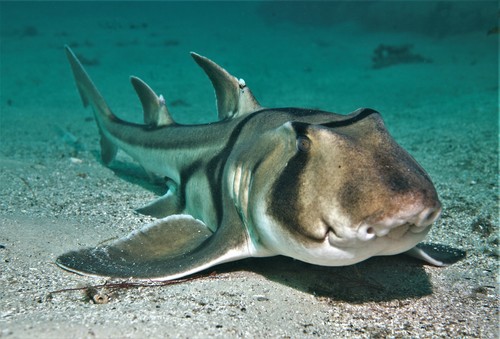
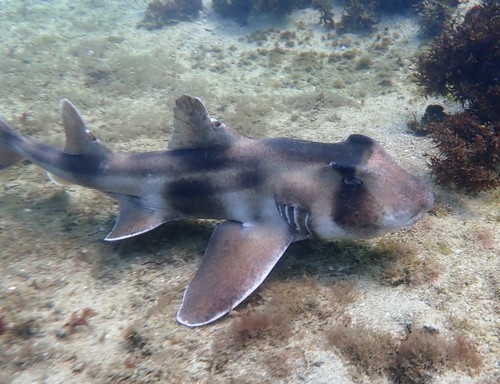
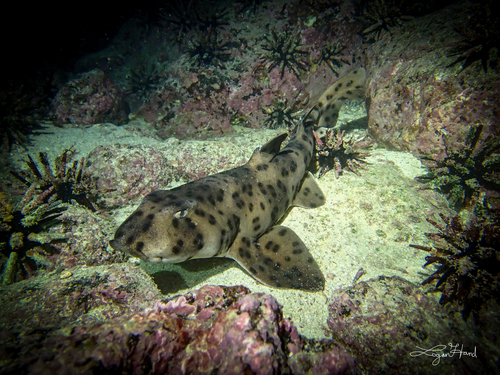
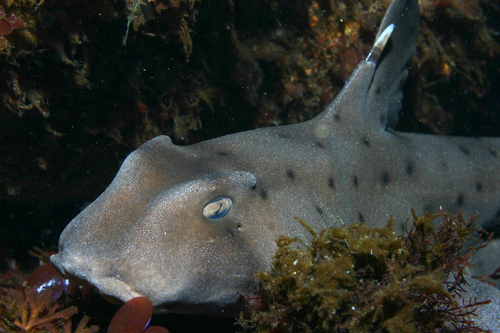
Like other bullhead sharks, the horn shark (Heterodontus francisci) has a short, wide head with a blunt snout and prominent ridges above its eyes. This species’ supraorbital ridges are low, end abruptly, and the space between them on top of the head is deeply concave. Each eye lacks a nictitating membrane, and a tiny spiracle sits just behind each eye. A long flap that reaches the mouth divides the nostrils into separate inflow and outflow openings. A groove encircles the inflow openings, while a second groove connects the outflow openings to the mouth. The mouth is small and curved, with prominent furrows at the corners. There are 19 to 26 tooth rows in the upper jaw, and 18 to 29 tooth rows in the lower jaw. Front jaw teeth are small and pointed, with a central cusp flanked by a pair of smaller lateral cusplets; teeth at the sides of the jaws are much larger, elongated lengthwise, and shaped like molars. The body is cylindrical, with two high, somewhat sickle-shaped (falcate) dorsal fins, each with a stout spine at its front. Fin spines of reef-dwelling horn sharks are shorter than spines of individuals that live in algal habitats, because movement over rocks wears reef-dwelling sharks’ spines down. The first dorsal fin starts above the bases of the large pectoral fins, while the second dorsal fin starts slightly forward of the free rear tips of the pelvic fins. The caudal fin has a short lower lobe and a long, broad upper lobe with a strong notch near the tip. Adult horn sharks have small, smooth dermal denticles that number approximately 200 per square centimeter on the back. Dorsal coloration ranges across shades of gray or brown with many small dark spots, though these spots may be absent in older sharks; the underside is yellowish. There is a dark patch of small spots below the eye. This species can grow up to 1.2 meters (3.9 feet) long, though most individuals do not exceed 1 meter (3.3 feet).
The horn shark lives on the continental shelf of the eastern Pacific Ocean, found off the coasts of California and Baja California from Monterey Bay southward, and in the Gulf of California. Uncommon northward influxes of warm water can carry the species as far as San Francisco Bay. Unconfirmed reports of this species off Ecuador and Peru likely represent misidentifications of other shark species. For most of the year, horn sharks are most common at depths of 2 to 11 meters (6.6 to 36.1 feet). When winter begins, they migrate to water deeper than 30 meters (98 feet). This species has been recorded in caves as deep as 200 meters (660 feet). Juvenile horn sharks between 35 and 48 centimeters (1.15 to 1.57 feet) long prefer sandy flats with low vertical relief, in water 40 to 150 meters (130 to 490 feet) deep. They often use large feeding pits dug by bat rays (Myliobatis californica) for shelter and access to food. As they mature, horn sharks move into shallower water, and their preferred habitat becomes structurally complex rocky reefs or algae beds. This strongly bottom-dwelling (benthic) species rarely travels more than 2 meters (6.6 feet) above the seabed. The relative population abundances of the horn shark and the co-occurring swell shark (Centroscyllim ventriosum) are negatively correlated: horn sharks prefer water temperatures warmer than 20 °C (68 °F), while swell sharks tolerate colder water better. At Santa Catalina Island, a 20-year warming trend has led to an increase in the horn shark population and a decrease in the swell shark population. Horn sharks are less common than swell sharks in the northern Channel Islands, where the water is cooler.
The horn shark is an irregular swimmer that prefers to use its flexible, muscular pectoral fins to push itself along the seabed. It is usually solitary, though small groups have been observed. During the day, horn sharks rest motionless, hidden inside caves or crevices, or within thick algal mats, but they remain relatively alert and will swim away quickly if disturbed. After dusk, they roam actively above the reef to search for food. Horn sharks hold small home ranges of around 1,000 square meters (11,000 square feet), and may stay faithful to the same range for over a decade, returning to the same shelter every day. The shelter is usually located at the edge of the shark’s foraging area. The longest documented movement by an individual horn shark is 16 kilometers (9.9 miles). The daily activity pattern of the horn shark is under exogenous control, meaning it is regulated by environmental factors rather than an internal physiological cycle. Observations of captive horn sharks show that the key regulating cue is light intensity: the sharks become active immediately after lights are turned off, and stop activity as soon as lights are turned back on. In one experiment where sharks were kept in constant darkness, they remained continuously active for 11 days before slowing, likely due to fatigue. In the wild, horn sharks exposed to bright light at night may stop swimming and sink to the bottom.
Larger fishes and the northern elephant seal (Mirounga angustirostris) prey on horn sharks, and eat adults, juveniles, and egg cases. At Catalina Island, bald eagles (Haliaeetus leucocephalus) also capture and eat horn sharks. Large marine snails can drill into horn shark egg cases to feed on the yolk inside. This species’ tough skin and spines provide some protection against predators: a Pacific angelshark (Squatina californica) was filmed engulfing a juvenile horn shark, then spitting it out because of its sharp spines. Documented parasites of this species include the tapeworms Acanthobothrium bajaensis and Acanthobothrium puertecitense, the copepod Trebius heterodonti, and the nematode Echinocephalus pseudouncinatus, which spends its larval stage inside prey items such as scallops and sea urchins.