About Heterocentrotus mamillatus (Linnaeus, 1758)
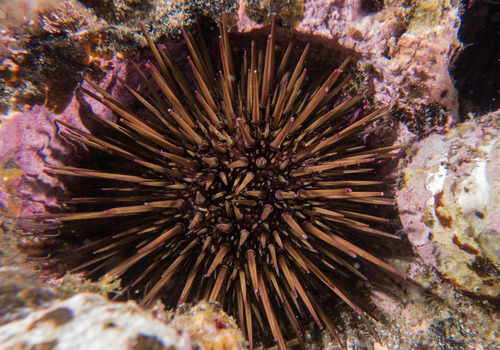
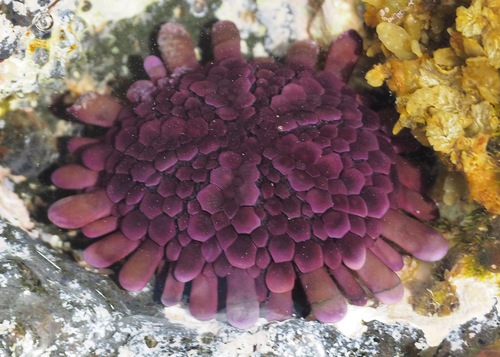
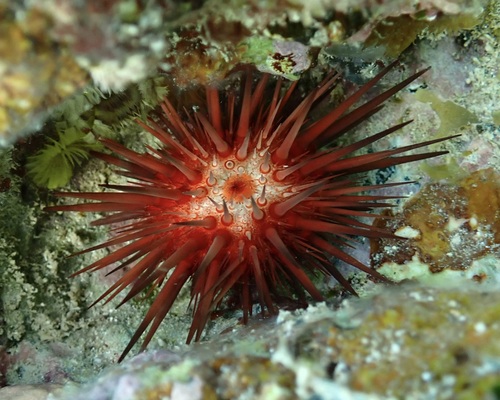
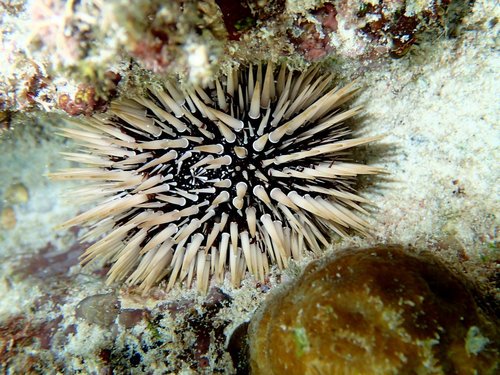
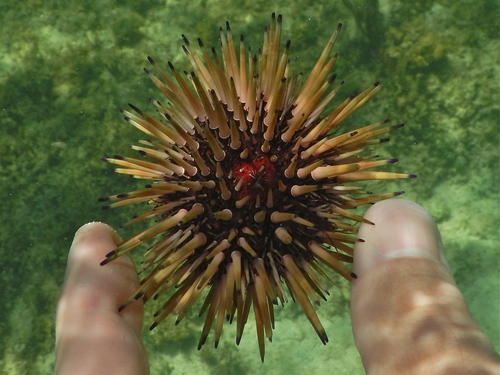
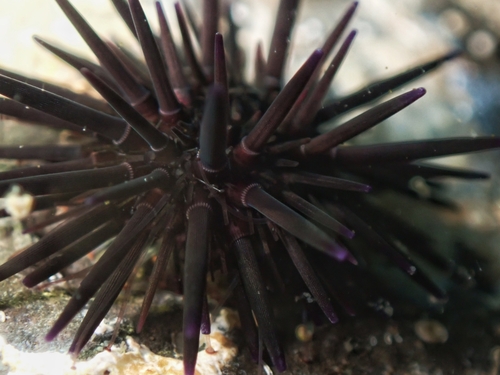
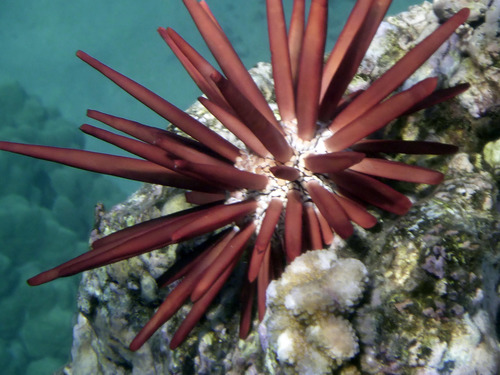
Heterocentrotus mamillatus (Linnaeus, 1758) is a large species of sea urchin. Some individuals reach over 8 centimeters in diameter, with spines that grow up to 10 centimeters long. Most specimens are bright red, though brown and purple color variants also occur. Spines may differ in color from the urchin's body; all spines have a white ring at their base, and alternating light and dark bands along their length. In cross-section, spines range from rounded to triangular, and taper toward the tip. A noticeable trait of red-spined individuals is that their spines change to a chalky pink color at night. Geographic variation in spine color occurs: specimens from Hawai‘i typically have bright red spines, while specimens from other parts of the Pacific often have yellowish or brown spines. Variants found on the Ogasawara Islands have slimmer spines, rather than the thick, broad spines that are characteristic of the species. There has been debate over whether this Ogasawara variant belongs to H. mamillatus or the related pencil urchin Heterocentrotus trigonarius, but researchers have concluded it is a form of H. mamillatus. H. trigonarius is a similar species that has longer, darker, more angular spines, and is always monochromatic. This species occurs throughout tropical Indo-Pacific waters, ranging from the east coast of Africa to Pacific archipelagos, and is particularly abundant in Hawai‘i. It can also be found on the shores of the Sinai Peninsula. H. mamillatus inhabits reefs at depths between 8 and 25 meters, roaming the subtidal zones of these areas. It prefers to burrow into hard substrates including limestone, coral, and basalt. Juvenile urchins of this species hide under rocks. Like other sea urchins, H. mamillatus periodically develops gametes to release into the water for fertilization, then goes through a resting period before repeating the reproductive cycle. The timing and duration of these cycles varies between individual urchins. A population of H. mamillatus from a reef near where the Gulf of Aqaba meets the Red Sea follows an annual reproductive cycle. For this population, the resting period falls between October and January, during which nutrients accumulate in the gonads to prepare for gametogenesis. Gametogenesis begins in January and finishes in May, by which point the gonads are almost completely filled with gametes. Spawning usually takes place between May and June, though all urchins may not finish releasing their eggs and sperm until October. The start and end dates of these reproductive stages are not fixed, and can shift by a couple of months. Data from this population suggests that spawning and gametogenesis may follow a lunar or semilunar cycle, meaning H. mamillatus could take timing cues from the Moon. Because spawning does not always occur during the same lunar phase, other factors such as the tidal cycle may also influence the timing of the species' reproductive stages.