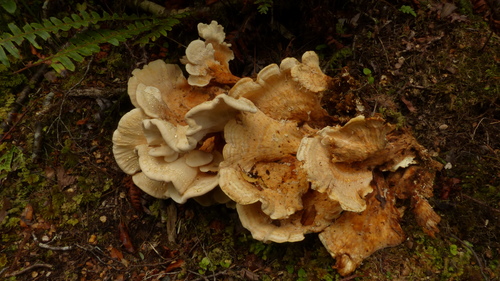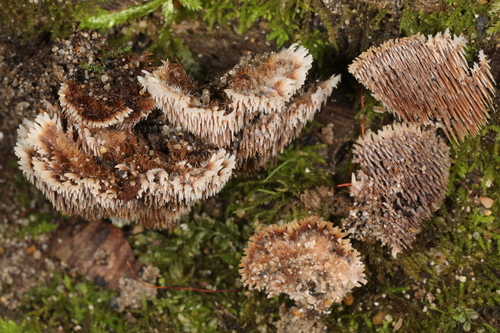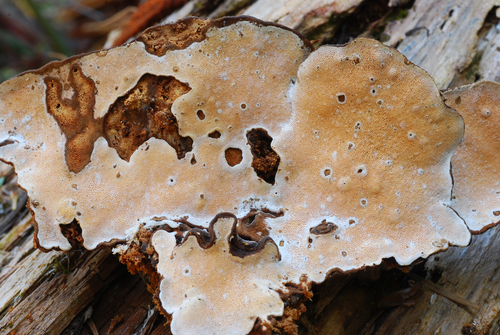
About Heterobasidion occidentale Otrosina & Garbel.
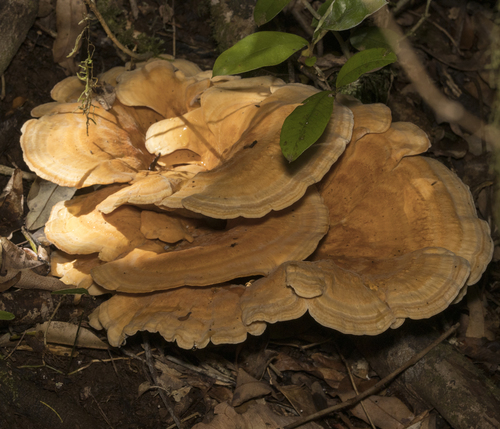
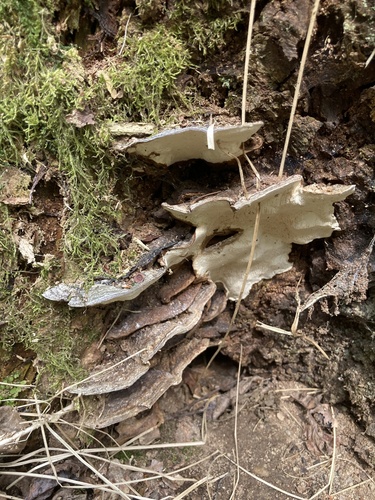
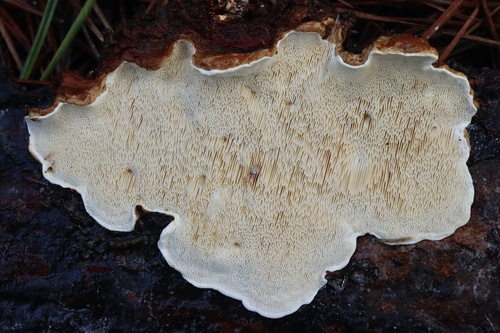
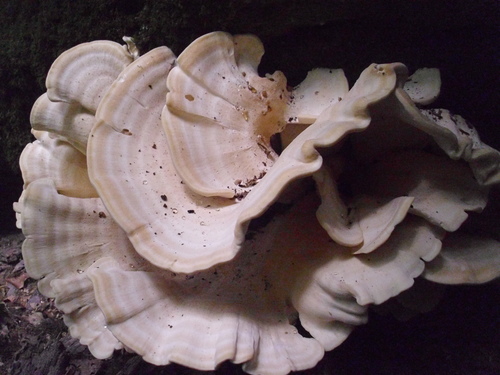
Description: The cap of this fungus is usually wider and commonly taller than the depth it extends out from wood. It measures 2–15 centimetres (1–6 inches) wide. When young, the cap is sometimes fuzzy, and it becomes knobby when old. The upper surface of its small shelf-shaped growth (called a conk) ranges from dark brown to black, with an irregular margin. Its larger base is covered in white spore tubes. The flesh is whitish and forms new annual tube layers each year. Infection of wood by this fungus causes a condition called white pocket rot, which can be identified by symptoms including dark discoloration of the heartwood near the tree base. Heavily diseased wood becomes soft, stringy, and fibrous, and may contain black specks running parallel to the wood grain. To quickly identify infection, wrap suspect wood in damp paper towels and leave it for 5–6 days; this will trigger the formation of the characteristic conidial anamorph form Spiniger meineckellus. The basidiospores of H. occidentale are spherical to ellipsoid, a feature distinctive to the family Bondarzewiaceae. Distribution and habitat: H. occidentale occurs in Western North America, ranging from Alaska to Southern Mexico. It grows as far inland as Colorado and Montana, and has not been observed east of the Rocky Mountains. It is particularly impactful in intensively managed silviculture stands, such as Christmas tree plantations. It is also a major concern in Abies religiosa forests in Central Mexico, which serve as the winter habitat for monarch butterflies (Danaus plexipus). The fungus forms perennial basidiocarps most often near the forest floor on the base or roots of living or dead affected trees, so these structures are frequently hidden under forest duff. Ecology: H. occidentale infects multiple tree species. Its major hosts are Douglas-fir (Pseudotsuga menziesii), western hemlock (Tsuga heterophylla), and various species of fir (Abies). Other notable hosts include sitka spruce (Picea sitchensis), plus a number of deciduous tree species: red alder (Alnus rubra), bigleaf maple (Acer macrophyllum), and pacific madrone (Arbutus menziesii). Ornamental and landscape trees are rarely affected by this fungus. This broad host range contrasts with the Eurasian S-type species H. parviporum, which has a relatively strict host limited to spruce, fir, and larch. Heterobasidion fungi can spread via conidia, basidiospores, and mycelia. H. occidentale cannot grow freely in soil, so it depends on aerial infection to spread to new hosts. Basidiospores are released from basidiocarps and travel through air to infect exposed sapwood on injured trees. Because the fungus produces perennial fruiting bodies, spores are present year-round, though the highest spore counts are recorded during spring and autumn in the Pacific Northwest. Forest disturbances such as pre-commercial thinning can increase spore release from infected forests. Conidia can travel through air, water, or soil, and can survive for up to 10 months in some soil types. Disease symptoms are more severe in well-drained soil with low organic litter content. Sites with neutral or alkaline soil conditions, such as former agricultural land, tend to experience more damage from the fungus than sites that have been continuously forested. H. occidentale can also spread directly between adjacent trees when the roots of a healthy tree contact the roots of an infected tree. This spread pattern can devastate forest stands by creating persistent 'circles of death' that are difficult to eliminate. Compared to disease circles caused by other root rot pathogens, however, the fungal genets that form these circles are not as large or as old as those caused by Armillaria or Phellinus.