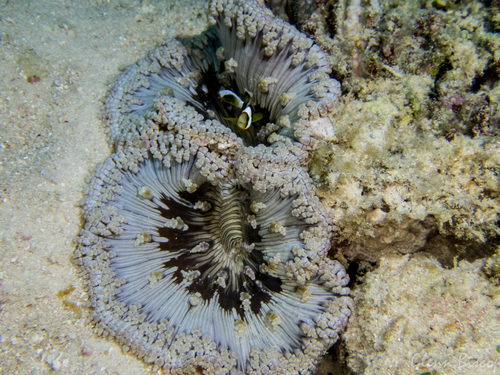
About Heteractis aurora (Quoy & Gaimard, 1833)
Both the tentacles and oral disc of Heteractis aurora are brown or purplish. Tentacles can grow up to 50 millimetres in length, may feel sticky when touched, and often have magenta-coloured tips. Longer tentacles have swellings that appear on only one side, or almost completely surround the tentacle, creating a beaded appearance. A single tentacle can have no more than 20 of these swellings. This species has a broad, flattened oral disc that reaches up to 250 millimetres wide, and may have white or brown markings that radiate out from the centre, and can even extend up and along the tentacles. Heteractis aurora is distributed across Micronesia, from Melanesia to East Africa, the Red Sea, and from Australia to the Ryukyu Islands. It inhabits areas among corals, along rocky reef edges and on slopes, typically in locations with strong currents. Individuals attach themselves to a surface and remain partially buried in sediment or sand, and will retract completely out of view into the substrate when threatened. Heteractis aurora acts as a symbiotic host to seven species of anemonefish: the Barrier reef anemonefish (Amphiprion akindynos), Allard's anemonefish (A. allardi), Two-band anemonefish (A. bicinctus), Clark's anemonefish (A. clarkii), Mauritian anemonefish (A. chrysogaster), Orange-fin anemonefish (A. chrysopterus), and Three-band anemonefish (A. tricinctus). The relationship between anemonefish and their host sea anemones has a highly nested structure. As it hosts seven anemonefish species, H. aurora is classified as a generalist anemone, though it is also considered a nursery anemone: for unknown reasons, it rarely hosts sexually mature fish. Several other species associate with H. aurora, but these relationships are commensal rather than mutual, as the anemone does not gain any benefit from the association. These associated species are porcelain crabs, shrimp of the genus Periclimenes, and threespot dascyllus.

