About Hesperoleucus symmetricus (Baird & Girard, 1854)
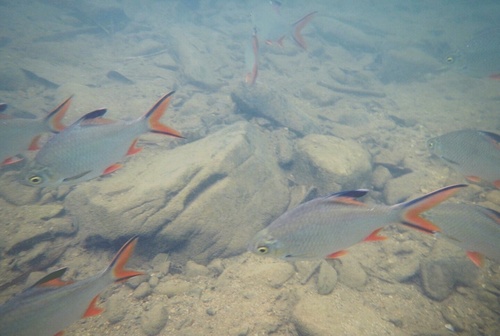
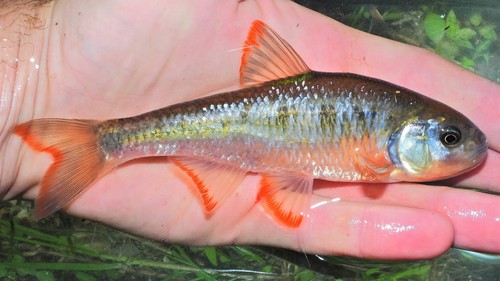
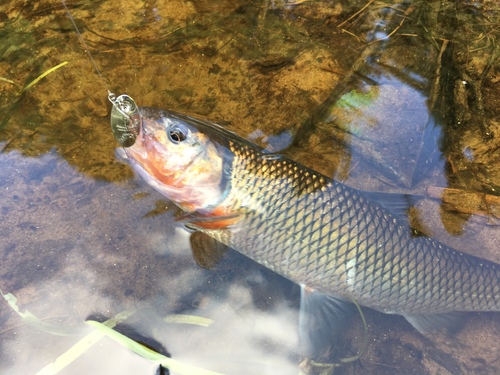
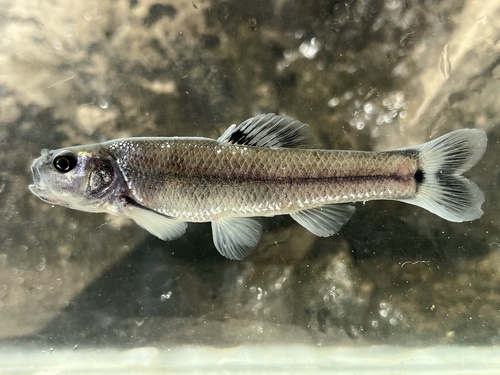
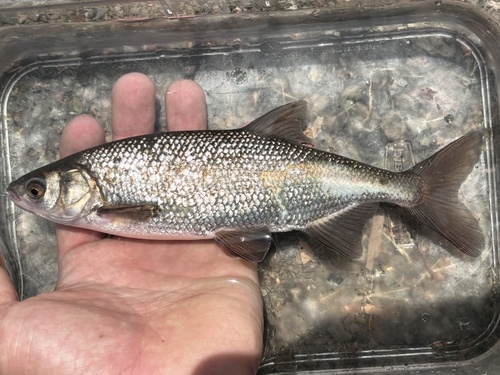
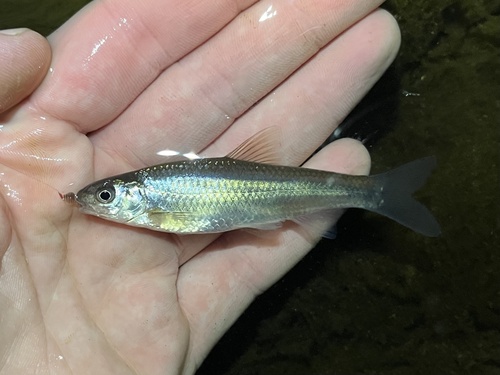
This species, commonly called California roach, has a small, stout body with a large conical head, large eyes, and a small, slightly subterminal or inferior mouth. Some individuals have a "chisel lip", which is a cartilaginous plate on the lower jaw. Most adults reach less than 100 mm (3.9 in) in total length, though some individuals have been recorded up to 150 mm (5.9 in) long. Their caudal fin is characteristically deeply forked, and connects to the body via a narrow caudal peduncle. The upper half of the body is dark, ranging in shade from dark gray to steely blue, while the underside is dull silver or white. Their scales are small, with 47 to 62 total scales along the lateral line. They have short dorsal and anal fins, with 8 to 10 dorsal rays and 7 to 9 anal rays respectively, and the dorsal fin is positioned behind the pelvic fins. Occasional individuals with extra fin rays are most often hybrids with Hitch or Chub species. Members of the California roach species complex, which includes multiple species and subspecies, are easily confused with one another. Certain traits, such as the chisel lip, are more common or pronounced in some species than others, but these differences are not reliable for certain identification. The most accurate methods to differentiate these species are genetic testing, or using knowledge of which watershed the individual was collected from. During the breeding season, red-orange patches develop on the chin, operculum, and at the bases of the pectoral, pelvic, and anal fins. The most consistent, universal characteristic features of California roach are a steeply forked tail, narrow caudal peduncle, large conical head, slightly subterminal mouth, and dorsal fin positioned behind the pelvic fins. California roach occupy a wide range of habitat types, from small, warm, intermittent streams to larger, cold trout streams. They can be found in rivers and streams of varying flow and depth, but are most abundant in areas of low to moderate flow and shallow depth. When predators, especially invasive predators, are present, California roach are restricted to pool edges and ripples, or are excluded from the area entirely. Historically, the California roach species complex was distributed across most tributaries of the Sacramento River and San Joaquin River, including the Pit River and Goose Lake, as well as many small coastal streams (including the Russian River, Pajaro River, Salinas River, Adobe Creek, and Permanente Creek) and backwater riparian regions of major rivers, all below 1000 m in elevation. This elevation limit is likely the result of natural barriers and steep high gradients. The modern distribution of California roach no longer includes many streams where the fish were historically found, due to invasive species and habitat alteration. Recent surveys have found California roach absent from the Fresno River, other San Joaquin River tributaries, and the San Joaquin River itself. Dam construction is one possible cause of local extirpation; for example, California roach were documented in the area of the Friant River until the construction of Friant Dam in the 1940s. Invasive species have also caused local extirpation across the species' historical range: invasive Redeye Bass have eliminated California roach from the Consumnes River. Other types of habitat alteration have also reduced California roach abundance and range; 19th century hydraulic mining in the upper Yuba River left the area almost completely devoid of California roach. California roach have also been introduced beyond their natural range barriers, most notably to Hetch-Hetchy Reservoir, which sits at 1,162 m (3,812 ft) elevation and contains predators. They were likely introduced here by anglers using them as bait.