About Hesperapis oraria Snelling & Stage, 1997
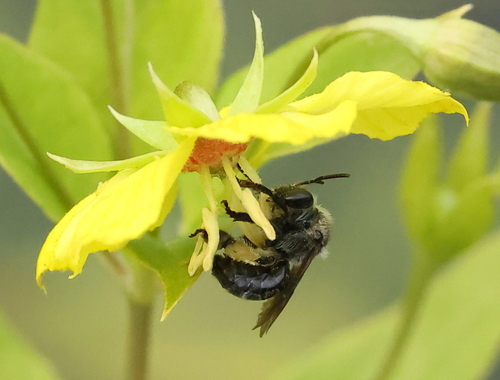
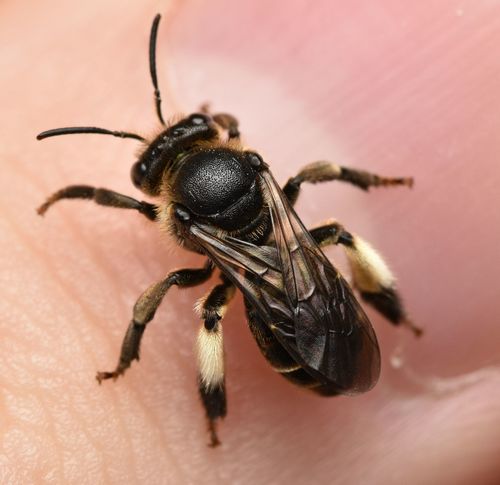
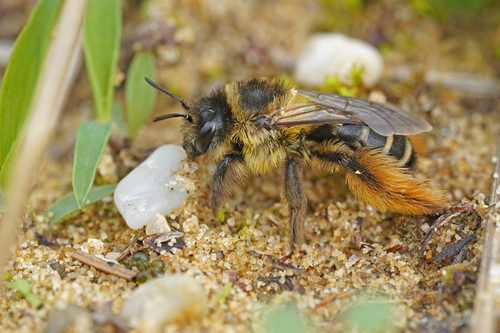
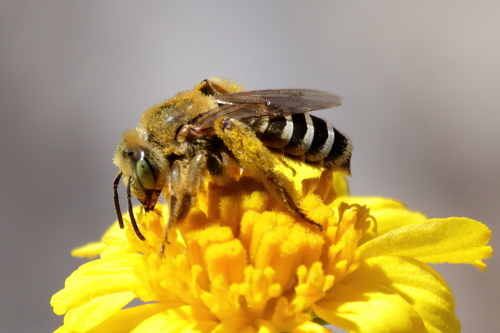
Hesperapis oraria, commonly called the Gulf Coast solitary bee, is monolectic, meaning it only gathers pollen and nectar from a single floral host: the coastal plain honeycomb head, Balduina angustifolia. Females of this species are 11 to 13 millimeters in length, while males are smaller, ranging from 8.5 to 11 millimeters long. Both sexes have shiny black, densely hairy heads, plumose or hairy yellowish mesosomas, clear to brownish wings, and hairy dark brown to reddish legs. The hairs on female metathoracic legs differ from those of males, and this difference is thought to assist with nest construction in sand. Males can be further distinguished from females by their distinctive subtriangular, pointed pygidial plate, while female pygidial plates are broad with angles greater than 45°. Both sexes have bodies covered in dense hairs, and their metasomas feature alternating dark and light colored bands. Melittidae is hypothesized to be the basal group of all bees, and in a recently constructed phylogeny, Dasypodainae is the most basal branch. The genus Hesperapis is only found in arid regions of South Africa and North America. The Gulf Coast solitary bee is the only known member of its genus Hesperapis, and of the subfamily Dasypodainae, found in eastern North America. 39 other named species of the genus occur in arid grasslands and deserts of western North America. When first described, the Gulf Coast solitary bee was only known to inhabit secondary dunes behind foredunes on barrier islands and coastal shores within 2 to 3 kilometers of the shoreline; current records confirm it occurs only within 500 meters of the shoreline. Gulf of Mexico barrier islands are long, narrow bands of sand that run parallel to the shore, extending from two miles west of Alabama east to Destin, Florida. These islands and adjacent coastal areas have foredunes that break incoming Gulf waves, with secondary dunes located behind the foredunes, and grasslands and temporary wetlands in the intervening swales. On wider sections of the islands, such as Perdido Key, vegetation on secondary dunes develops into wood scrub forest. Because the Gulf Coast solitary bee is monolectic and does not switch host plants, its habitat must contain both dense patches of its only pollen host, the Coastal Plain honeycombhead, and appropriate nesting substrate within flight range of the host plants. The Gulf Coast solitary bee uses honeycombhead patches that lie less than 475 meters from the coastline, and the plant prefers habitat more than 110 meters from the shore, so the bee is most likely found between 110 and 475 meters from the Gulf coastline. On a regional scale, the bee requires at least 12 honeycombhead patches per site, and on a landscape scale, total patch area must be at least 111.5 square meters, equal to at least 2.5 plants per square meter. In 2011–2012, the bee was found at higher densities on coastal mainland sites, which had three times as many honeycombhead patches as barrier islands. The bee does not occur in honeycombhead stands on non-coastal mainland sites, even those with dense patches of the host. Since the Gulf Coast solitary bee’s range is far smaller than that of its host plant, its habitat is restricted by additional factors, most likely the presence of bare patches of fine sandy soil for nesting, and the intermediate levels of disturbance needed to maintain its dune habitat. Dune habitat is dynamic and disturbance-dependent, constantly changing due to wind, water, storms, and fire, which creates a naturally patchy distribution of honeycombhead and other vegetation in the dune ecosystem. Both the bee and its host plant are found at higher densities on coastal mainland sites, which may be due to reduced high-intensity storm disturbance in these areas. Low-intensity fires are a common natural component of these ecosystems that maintain bare ground and patchy vegetation. The bee’s coastal and island habitats are separated from non-coastal mainland honeycombhead patches by development or dense scrubland that formed after natural fire was suppressed, reducing habitat connectivity. For this reason, the Gulf Coast solitary bee and its host plant require a moderate level of disturbance in their naturally shifting dune habitats. Nests of the Gulf Coast solitary bee are built in the deep, soft sandy soils of its dune habitat, and they may lie no more than 2 kilometers from the shore, as the species is restricted to the crumbly sands of back-dune habitats. Based on where adult bees are found, nests are more likely located around 500 meters from the Gulf shore. Nesting resources are a key factor for the viability of solitary bee populations, but Gulf Coast solitary bee nests are difficult to locate. Proxy measurements of fine sandy soil with bare ground and proximity to host plants can be used to estimate nesting site availability and habitat quality. One female Gulf Coast solitary bee has been recorded digging a burrow in fine sand within the largest local honeycombhead patch at Fort Pickens. The Gulf Coast solitary bee has a narrow distribution. Its historic known range is a narrow strip along the northern shore of the Gulf of Mexico, extending approximately 320 kilometers linearly from Horn Island in eastern Mississippi to St. Andrew's Bay in northwestern Florida, across the U.S. states of Florida, Alabama, and Mississippi. Despite extensive surveys for the bee across the region, even within dense patches of its host plant (which also grows on the Florida peninsula and in southern Georgia), the bee was only found in sites 1 to 2 kilometers from the coast when it was described in 1996. Additionally, the Gulf Coast solitary bee was not found on small barrier islands that host its host plant, such as Petit Bois Island in Mississippi, nor on islands or areas without honeycombhead, including Dauphin Island, Alabama, and Crooked Island and Shell Island, Florida. No surveys for the bee have been conducted outside of Florida since the original description, so it has not been recorded in Mississippi or Alabama since 1994. Adult Gulf Coast solitary bee activity aligns with the September and October bloom of its pollen host, the coastal plain honeycomb head. This species is thought to be univoltine, producing one generation per year. Over the few weeks they live as adults, mated females build underground nests and lay eggs. Females provision each brood cell with a pollen ball, lay a single egg on the pollen ball, then seal the cell and leave the offspring to hatch and develop into likely five instars. The final larval stage enters diapause as a pre-pupa, or post-defecating larva, before pupating and emerging as an adult. Male Gulf Coast solitary bees often sleep on and patrol honeycombhead flowers searching for females, and have been observed attempting to mate on the flowers. Since none of these observed mating attempts were successful, it is assumed that most mating occurs at nest sites. It is also possible that patrolling males simply have a low success rate, and mating does occur near host plants, such as at the base of plants. Males also rest on flowers during severe weather. Male activity on flowers contributes to the species’ efficacy as a pollinator of the coastal plain honeycomb head. While the nesting biology of the Gulf Coast solitary bee has not been specifically described, the 14 members of the Carinata group, a subgenus of Hesperapis, build nests in soft sand such as that found in dunes. Female Gulf Coast solitary bees have modified setae on their hind basitarsi that form a trough-like depression used to excavate nests in sandy soil. Other members of the subgenus nest in aggregations, with up to 25 burrows per square meter in sandy soil. Each burrow holds one to six individual larval cells within a 30 centimeter radius, at a depth of around 25 to 30 centimeters. Female Hesperapis do not line larval cells, and larvae do not spin cocoons. However, post-defecating Hesperapis larvae are coated in a rigid integument-like material that may regulate moisture. The Gulf Coast solitary bee may exhibit bet hedging, a reproductive strategy that reduces between-year variation in reproductive success and increases overall survival in ecosystems with unpredictable annual weather conditions. In response to unpredictable habitat, bees often enter extended diapause for two or three years, delaying emergence until their host plant blooms. Monolectic bees cannot switch pollen sources if they emerge when their host plant is not blooming, so they have evolved emergence timing that is synchronized with their host’s blooming period, using environmental cues to trigger emergence. At least one related species, Hesperapis rhodocerata, has been documented to exhibit extended diapause, only emerging when sufficient rainfall leads to blooms of its preferred pollen host.