About Herpsilochmus rufimarginatus (Temminck, 1822)
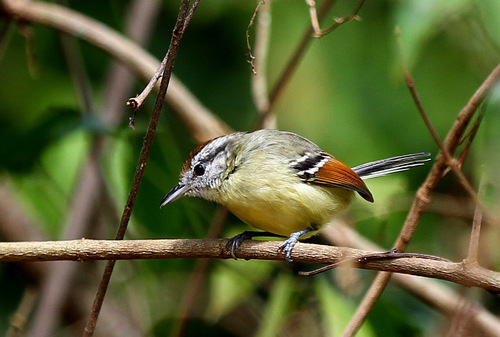
Description: The rufous-margined antwren measures 10 to 12.5 cm (3.9 to 4.9 in) in length. Adult males have a black crown and nape, a broad whitish supercilium, a black stripe running through the eye, and ear coverts mottled with black and either white or pale yellow. Their upperparts are mostly olive-gray with scattered black patches, yellow uppertail coverts, and white tips on the outer scapulars. Their wing coverts are black with white tips; their flight feathers are olive-brown tinged with dark gray, and have bright cinnamon-rufous edges. Their tail is mostly dark gray with white tips on the feathers, and the outermost pair of tail feathers is entirely white. Their throat and underparts are light yellow, with an olive tinge on the flanks. Adult females have a rufous forehead, a rufous-brown crown, and an olive-brown back. Their wings, tail, and underparts match those of the male. Distribution and habitat: The rufous-margined antwren has a disjunct distribution. One small population occurs north of the Rio São Francisco in Pernambuco state, Brazil. The other population ranges from Bahia in southeastern Brazil southward into Paraguay and northeastern Argentina. This species primarily lives in the interior of humid evergreen Atlantic Forest, occurs less often at forest edges, and is found locally in restinga woodlands growing on white-sand soils. It typically occurs from the forest mid-storey up to the subcanopy, and favors dense vine tangles. Its elevational range extends from sea level to approximately 1,100 m (3,600 ft).