About Herpsilochmus atricapillus Pelzeln, 1868
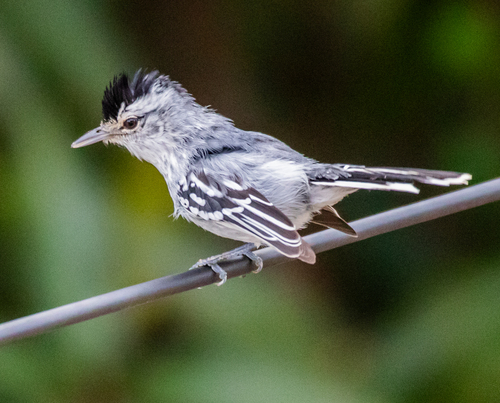
Herpsilochmus atricapillus, commonly called the black-capped antwren, measures 11 to 12 cm (4.3 to 4.7 in) in length and weighs 8 to 11 g (0.28 to 0.39 oz). Adult males have a black crown and nape, a long white to pale gray supercilium, and a black streak running through the eye. The rest of their upperparts are gray, with blackish scapulars edged in white and a white patch between the scapulars. Their wings are black, with white tips on the coverts and white edges on the flight feathers. Their tail is black, with large white tips on all feathers and white edges on the outermost feathers. Most of their underparts are gray to pale gray, with a white belly. Adult females have a buffish forehead and a black-and-white streaked crown. Their upperparts are gray with an olive tinge, and their underparts are white, with a somewhat ochraceous breast and a pale buff tinge on the rest of the underparts. Both sexes show variation in the darkness and intensity of their plumage colors. The black-capped antwren has a distribution extending from Maranhão and Rio Grande do Norte in northeastern Brazil, south to Mato Grosso, Mato Grosso do Sul and extreme western Paraná and São Paulo. It also ranges into southeastern Bolivia, the northwestern Argentinian provinces of Jujuy and Salta, and northern and eastern Paraguay. It inhabits all vegetation levels of several forest types, including deciduous, semi-deciduous, evergreen, and gallery forest. In northeastern Brazil, it favors caatinga woodland, semi-deciduous mata-de-cipó, and humid evergreen forest. Across most of its range, it occurs at elevations from sea level up to 800 m (2,600 ft); at the base of the Andes in Bolivia and Argentina, it can be found as high as 1,450 m (4,800 ft).