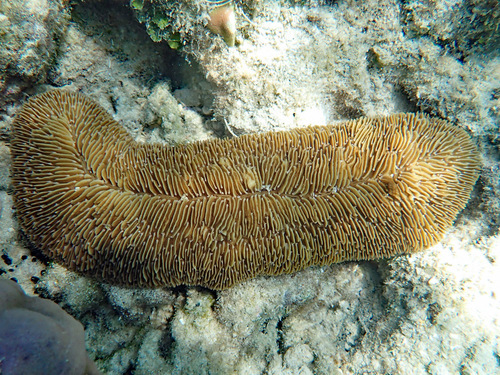
About Herpolitha limax (Esper, 1792)
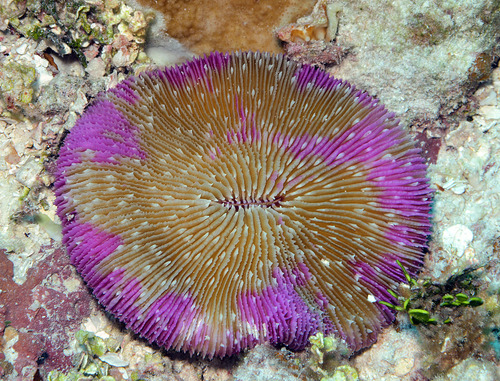
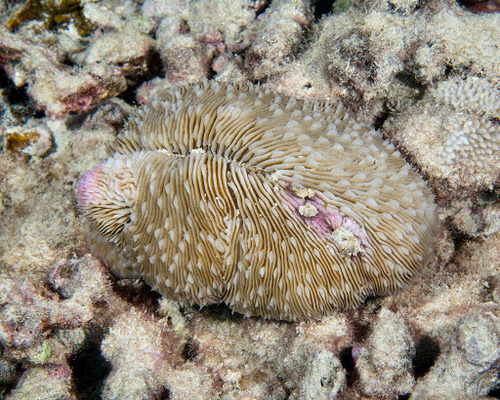
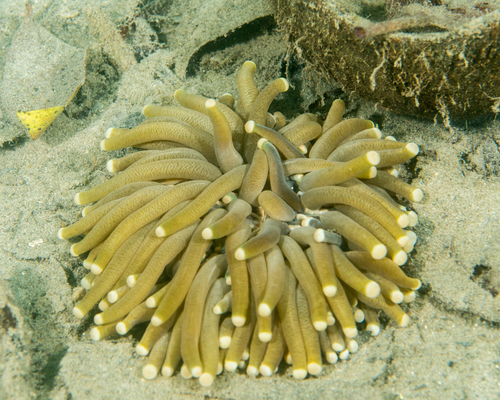
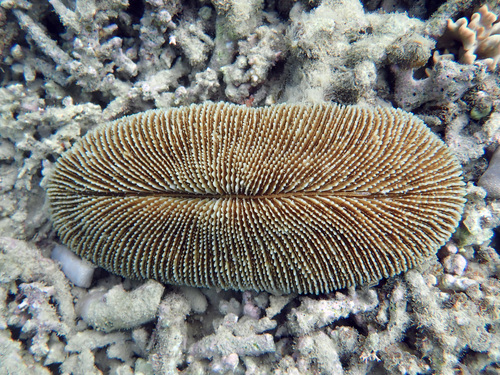
Herpolitha limax (Esper, 1792) has an elongated body with slightly rounded ends, and a single central axial furrow that runs nearly the full length of the structure. Many prominent slit-like mouths are located within this furrow, while other less distinct mouths are scattered irregularly across the rest of the coral. The primary septa have dense fine spine-like teeth and do not extend to the edge of the colony. The costae are low and covered with crowded, blunt teeth. Occasionally, the central furrow becomes forked, forming Y, T, or even X shapes. This coral can reach a length of 45 cm (18 in) or more, and its color is typically a shade of grey, brown, or greenish-brown. Herpolitha limax is native to the Indo-Pacific region, with a range that stretches from East Africa and the Red Sea to Australia, Indonesia, Papua New Guinea, and the South Central Pacific. It inhabits reef slopes and lagoons, often growing close to Fungia species at depths of up to around 30 metres (98 ft). Herpolitha limax is a colonial, free-living, zooxanthellate coral species. It is prone to coral bleaching under stressful conditions, turning white after expelling its symbiotic algae. During a period of high water temperature in Thailand in June 2010, bleaching was widespread and affected 52% of this species' corals, alongside many other mushroom coral species. By the following February, the corals appeared to have fully recovered, with no remaining signs of thermal-induced bleaching, and species composition matched what it was before the bleaching event.