About Herpetotheres cachinnans (Linnaeus, 1758)
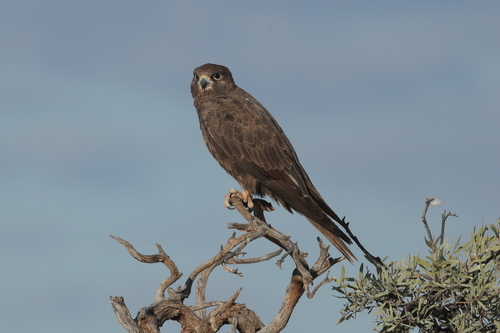
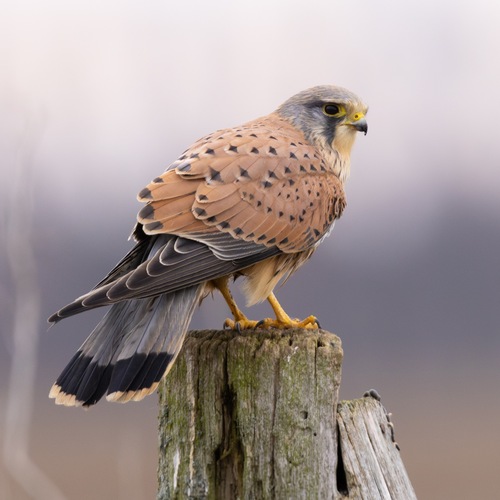
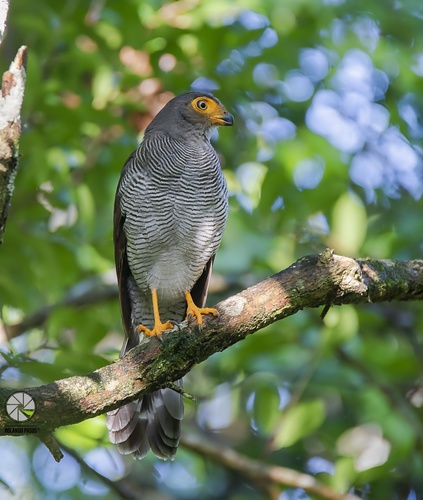
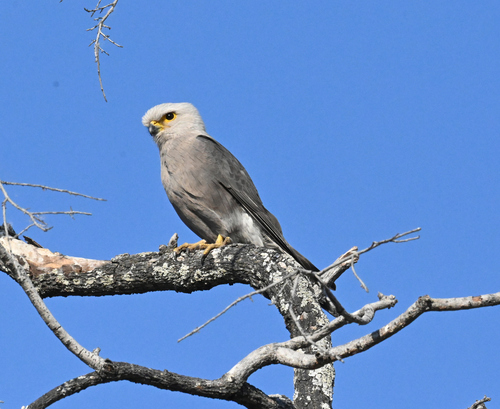
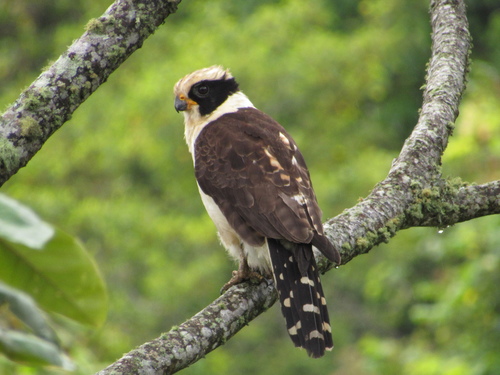
Herpetotheres cachinnans, commonly called the laughing falcon, measures 45 to 56 cm (18 to 22 in) in length, with a wingspan of 79 to 94 cm (31 to 37 in). Females are slightly larger than males and noticeably heavier: nominate subspecies males weigh 408 to 686 g (0.9 to 1.5 lb), while nominate females weigh 590 to 800 g (1.3 to 1.8 lb). The subspecies H. c. fulvescens is slightly smaller than the nominate subspecies. Male and female laughing falcons have identical plumage. Adult nominate laughing falcons have creamy white underparts, which vary slightly between individual birds, across seasons, and with feather wear. They have a broad dusky black facial "mask" that extends around the neck as a narrow collar. Their crown has dusky black feather shafts that appear as narrow streaks, and the back of the crown holds a small bushy crest. Their back and wings are dusky black. Their tail is also dusky black, with four or five white bands, though some individuals have white spots instead of bands. The uppertail coverts range from pale buff to cream. The underside of the wing is pale buff, sometimes with some dusky spotting on the underwing coverts; flight feathers have cinnamon rufous bases and darker bars. The iris is dark brown or hazel, the bill is black with a pale yellow to orange-yellow cere, and the feet are typically dull yellow. Immature laughing falcons differ very little from adults; they have lighter edges on their back feathers that create a scalloped appearance. Some immature individuals have cinnamon buff or dusky streaks and spots on their underparts. When in flight, the laughing falcon displays a rufous patch at the base of the wing underside, and has a body shape more similar to Accipiter hawks than most other falcons, with short, rounded wings and a long tail. Subspecies H. c. fulvescens shares the same plumage pattern as the nominate, but is overall darker and more richly colored, with a cinnamon buff underside rather than creamy white. The nominate subspecies of the laughing falcon is the much more widespread of the two. It ranges from southern Sonora and San Luis Potosi south through Central America, extending from northeastern Panama into northern Colombia. In South America, its range continues east through Venezuela, the Guianas, and northern Brazil to the Atlantic Ocean; to the south, it occurs east of the Andes through Ecuador, Peru, Bolivia, and Paraguay into northeastern Argentina, and across most of Brazil. Subspecies H. c. fulvescens ranges from Panama's Darién Province south through western Colombia and western Ecuador into northwestern Peru, as far as the Department of Lambayeque. The laughing falcon lives in a broad variety of semi-open landscapes with trees, and avoids the interior of dense forests. It can be found in primary evergreen and deciduous forests, gallery forests, secondary forests, palm groves, savannas, and other open areas that have scattered trees or patches of forest. It is generally a lowland bird, found from sea level upward. In most of Central America it reaches up to 1,500 m (4,900 feet), though it occurs locally up to 1,850 m (6,100 feet) in Costa Rica. In Colombia it reaches 2,400 m (7,900 feet), but usually occurs at much lower elevations. It occurs mostly below 800 m (2,600 feet) in Ecuador, 1,000 m (3,300 feet) in Peru, and 900 m (3,000 feet) in Bolivia.