About Herpestes smithii Gray, 1837
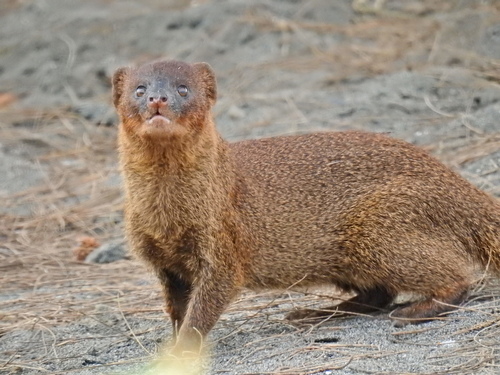
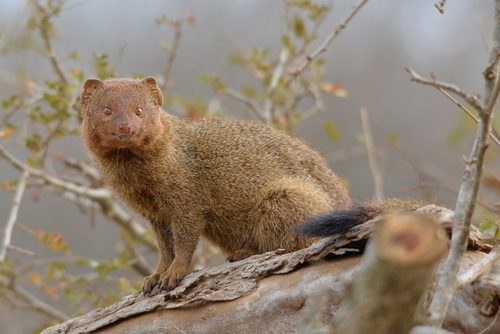
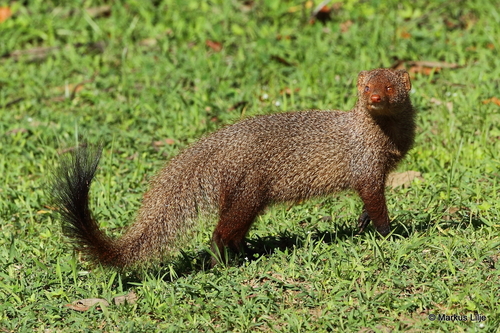
The ruddy mongoose (Herpestes smithii Gray, 1837) is a large mongoose species with greyish-brown fur. Its average head-to-body length measures 40–45 cm (16–18 in), and its tail reaches 36 cm (14 in) in length. The long tail has a darker tasseled tip that is usually curved upward, and this feature is visible from a distance.
The ruddy mongoose occurs in forests and shrublands of India and Sri Lanka. It is primarily a forest-dwelling species that favors more secluded areas. It has also been recorded foraging in secluded paddy fields within this region. It is currently classified as Least Concern on the IUCN Red List.
This species is active and hunts during both the day and night. Its diet consists of birds, rat snakes, land monitors, rodents, and snails. It is generally solitary, but has been observed in monogamous pairs during the mating season. Wild family groups of up to five individuals, made up of a mother and her pups, have also been recorded. Though usually found in thick jungles and along forest edges, the ruddy mongoose will occasionally enter paddy fields and tea estates. When confronted by humans, it quickly retreats into a crevice or under a rock shelf. If cornered, it often acts aggressively while producing loud, shrill noises.