About Herpestes fuscus Waterhouse, 1838
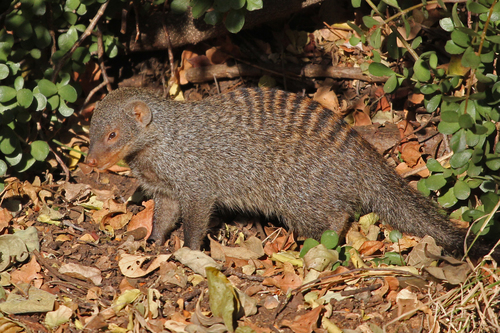
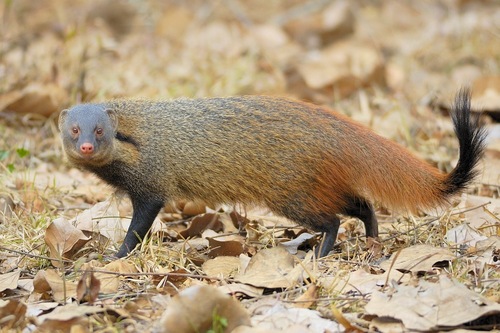
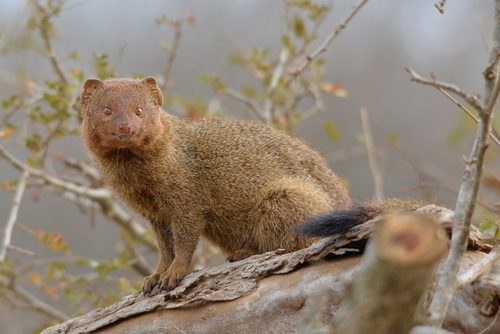
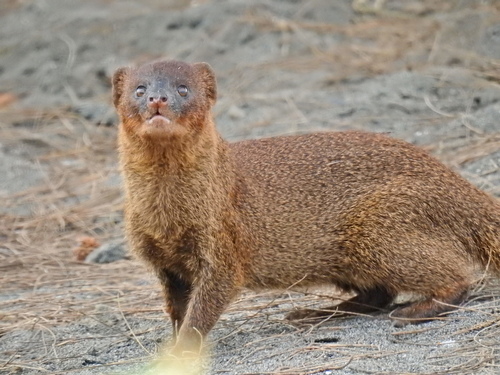
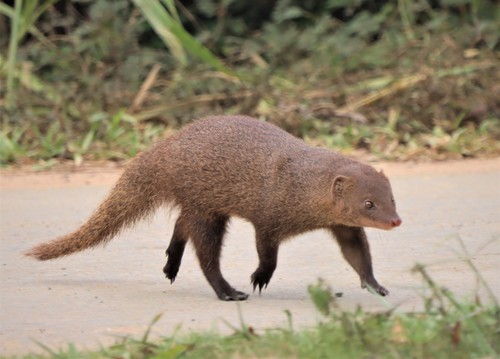
Characteristics: Compared to other mongoose species found in the southern Western Ghats, the Indian brown mongoose is larger in size. Its body is dark brown, and its legs are distinctly black. The head-to-body length of this species ranges from 33 to 48 cm, while its tail measures 20 to 34 cm, which equals around two-thirds of its head-to-body length. The tail is also furrier than that of the small Indian mongoose. A pointed tail and fur beneath the hindleg are distinguishing features that separate this species from other mongoose species. Males are larger and heavier than females, reaching a weight of 2.7 kg. Young Indian brown mongooses are much darker in color, and have yellowish eyes.
Distribution and habitat: In southern India, the Indian brown mongoose occurs at elevations between 700 and 1,300 m (2,300 and 4,300 ft), ranging from Virajpet in southern Coorg and Ooty in the Nilgiri Hills, Tiger Shola in the Palni Hills, High Wavy Mountains in Madurai, Kalakad-Mundanthurai in the Agasthyamalai Hills, Valparai plateau in the Anamalai Hills, to Peeramedu in Kerala. In Sri Lanka, this species is restricted to the west coast, central hills, and western urban centers. It was introduced to Fiji in the 1970s, where it lives in sympatry with the Javan mongoose.
Behaviour and ecology: The Indian brown mongoose is nocturnal, solitary, and inhabits dense forests. In Sri Lanka, it favors jungle patches covered with ferns and brush over tea estates. It is generally a shy animal that avoids human settlements, though it sometimes enters suburban gardens to feed on snakes and mice. When threatened, it flees to a hole or termite mound, but will fight ferociously if cornered. When preparing to breed, Indian brown mongooses burrow in densely packed rock formations, and give birth to two to three young. The Indian brown mongoose is an opportunistic carnivore, feeding primarily on small rodents, snakes, lizards, spiders, grubs, birds, eggs, and frogs, and will occasionally eat berries and flowers as well. When hunting, it stops completely to detect sounds produced by prey, then quickly pounces and delivers a bite to the prey's head. Parturition typically occurs in a well-concealed burrow dug into an embankment, under a rock, or inside an anthill. Females can give birth to three to four pups at any time of the year.