About Herpestes edwardsi (É.Geoffroy Saint-Hilaire, 1818)
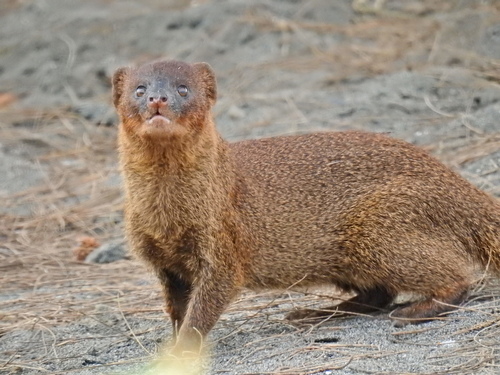
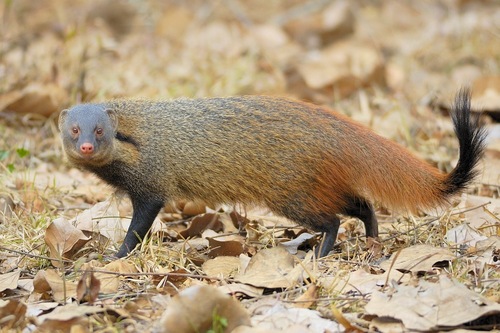
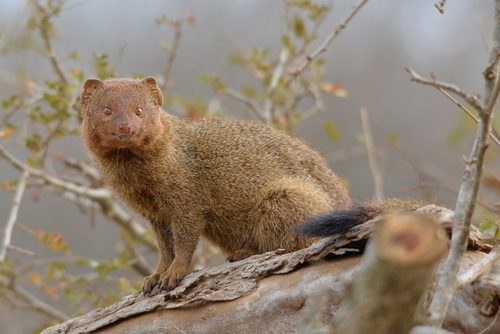
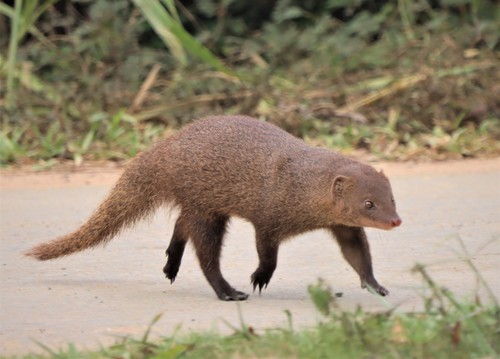
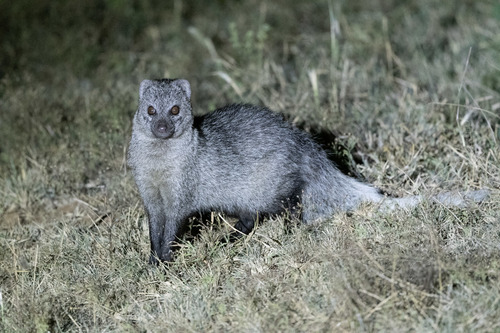
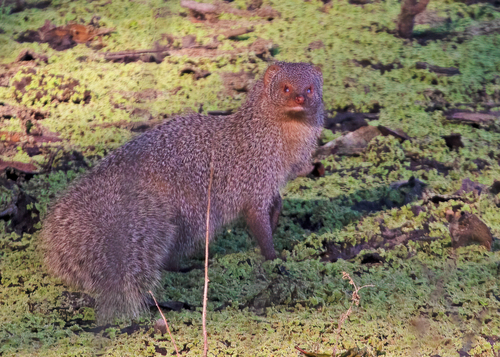
The Indian grey mongoose, Herpestes edwardsi, has tawny grey or iron grey fur that is more grizzled, stiffer, and coarser than the fur of other mongoose species. While the degree of ruddiness in its coat varies across subspecies, the species overall appears more grey than other mongooses. Its grizzled appearance comes from individual hairs that are ringed with creamy-white and black. Its legs are brown and darker than its body, and the hair around its muzzle and eyes is brown with a stronger rusty red tint. Its tail is bushy, and any colored tip of the tail is pale yellow or white. Its tail length equals its body length: body length ranges from 36–45 cm (14–17 inches), tail length reaches up to 45 cm (17 inches), and body weight ranges from 0.9–1.7 kg (2–4 lb). Males are significantly larger than females. Unusually among mammals, the Indian grey mongoose can discriminate four colors, more than most other mammal species. It is generally accepted that the Indian grey mongoose is found in Saudi Arabia, Kuwait, Bahrain, Iran, Afghanistan, Pakistan, India, Nepal, Sri Lanka, and Bangladesh. A 2007 study identified specimens in Turkey and the United Arab Emirates, extending the species' known range. Despite being a common animal, the natural history of the Indian grey mongoose is not well understood. It can occupy a wide variety of habitats and prefers open habitat types, including grasslands, open areas, rocky patches, scrub, semi-desert, cultivated fields, other disturbed areas, thickets, bushy vegetation, dry secondary forest, thorn forest, and forest edges, and it also occurs near human settlements. While the species is described as being less dependent on human settlements, observations in heavily forested areas of India show it is much more common around human settlements, where it often scavenges on waste. The Indian grey mongoose is omnivorous, and as an opportunistic hunter, most of its diet consists of live prey, with mice, rats, lizards, snakes, and beetles making up the bulk of its diet. It also eats ground birds, their eggs, grasshoppers, scorpions, centipedes, frogs, crabs, fish, and plant parts including fruits, berries, and roots, and it also takes larger prey such as hares and egrets. It kills prey by delivering a bite to the neck or head. This species is well known for its ability to fight venomous snakes. It primarily wears snakes out by luring them into making repeated strikes that it avoids acrobatically. Additional defenses against venomous bites include its stiff fur, which stands erect during encounters, its thick loose skin, and specialized acetylcholine receptors that make it resistant or immune to snake venom. When hunting scorpions, it takes no special measures to disable the sting and picks them up regardless. The Indian grey mongoose typically opens eggs by holding them between its paws and biting a hole in the small end. Smaller mongooses usually open eggs by throwing them between their legs against a hard surface, so it has been speculated that adult Indian grey mongooses use this same method for large eggs. The Indian grey mongoose mates two to three times each year, between March and October. The gestation period lasts 60 to 65 days, and females give birth to two to four offspring. In the wild, the Indian grey mongoose has a lifespan of seven years, while captive individuals live up to 12 years.